Most game designers are very concerned with the notion of “balance” in the games they make. Systems that use a point-based creation mechanic for character creation often have levels of generation points that allow a player to customize their character, yet are all bought for the same “level” — being it novice or beginner, experienced/whatever, or expert/master, etc. In Dungeons & Dragons, characters used to start at 1st level and work their way up, but later iterations allowed for starting at higher levels…but you still had the same approximate range of abilities.

Until you hit the min/maxers and rules lawyers that can manipulate the system to build a character more effectively than other players. (I have a mathematician in the group right now who is an expert at this…)

The point to this notion of “balance” is “fairness”. Young players, players that use gaming to vicariously experience success or greatness, often don’t like the notion of having a player be weaker or stronger than others in a campaign. Everyone wants to be the hero, and balance is supposed to push the players toward a more ensemble model, where everyone is equally important to the game. It’s a nice ideal — and one that I subscribed to for a long time — but it’s not really achievable.

Problem, the first: All players are not created equal. Maybe your characters were all created for X number of points, but you have a rules lawyer that has made a character perfectly tailored to the sorts of adventures you will encounter, making them the “go to guy” all the time. It’s great for that player; they’re almost always now the center of attention. Even if, somehow, you managed to have characters that were all highly specialized and had their particular spotlight moments in a game session, some players are more passive, and others more active — one guy may spend all his time in his room inventing things, and only becomes a factor in play when the fight is on. Maybe a player is particularly clever at using a “weak” character to achieve greatness. Maybe one of them is just too funny to reign in and makes the game enjoyable. These players are going to capture most of the airtime.

Problem, the second: It’s not the way good storytelling works. In books, movies, and television — even with ensemble casts — there’s normally a lead or two that the stories focus on. For example, let’s take any of the Star Trek series from The Next Generation on…there’s an ensemble that sees the whole cast get some screen time, but normally, the focus is on one or two of the characters per episode, and often over the course of the series. Let’s look at The Lord of the Rings (books and movies) — Frodo is the main protagonist on the quest to destroy the Ring, with Sam as his sidekick, but arguably just as important. But Aragorn is the lead for the portions involving the return of the king and opposing the forces of Mordor. Frodo is in no way Aragorn’s equal (and arguably not up to that of Sam, either…) But he is the lead and the lead not need be the biggest bad ass of the bunch. Even Merri and Pippin are stuffed into the middle of great conflicts, and probably couldn’t resist a late-night mugging in any modern city. It’s not about being bad ass; the interesting part of characters is their weaknesses and how they overcome obstacles. Simply hacking your way through a problem like Schwarzenegger might have a certain appeal, but it’s not especially memorable after the first hundred kobolds, is it?

Problem, the third: Not everyone wants to be the bas ass. I have a player whose real interest is in the politics and social machinations in nearly every game we play. He often winds up being the politician, ship captain, leader because that’s the sort of thing he likes. Even when he had action star-type characters, he would often use other characters as proxies in fights. Some guys thrive on being the ass-kicker and trying to suss their way through a mystery is either boring or taxing…they like to sit and wait until it’s time to break the “in case of emergency” glass on their barbarian and let the carnage begin.

So what’s the point of attempting game balance, other than an attempt to preserve some sense of Harrison Bergeron-esque enforced equality? I’d submit none.

Here’s an idea — when in the planning stages of a campaign, there are a few things the GM and players can do to create engaging characters that are appropriate to the sorts of adventures in store for them. On the players’ side is arguably the harder job — letting go of the ego long enough to create characters that have a reason to be together, more than focusing solely on your cool concept.

Example 1: I had a player that had his high concept character — a Starfleet engineer who was super-talented, so that he didn’t have to play by the rules and regulations. Great idea, save for a few points: 1) everyone in friggin’ Starfleet is smart, educated, and competent, 2) the character’s purpose is to spotlight hog and create artificial conflict (specifically with the GM and the adventure itself, I suspect), 3) he’s got no logical reason to be there, other than to annoy everyone else at the table.

Example 2: In a short-lived Supernatural game, one of the players decided to play the overweight, stereotypical hacker/geek that ran a supernatural conspiracy website. He was the outsider of the group, but was useful (and played very amusingly) enough that he was essential in the investigation portions of the adventures, but was completely out of his element once they found the creature of the week. The spotlight then shifted to the other characters. They meshed, even with the built in conflict between the characters because they needed each other, and — after a few encounters — wanted to work together.

The first example was built to the same number of creation points as the other characters, but was specialized in away that, while it could have been highly useful, was mitigated by the assholish persona of the character. No one went to him for help. The players and characters hated the character in question.

The second example created highly memorable moments in the game that were fun enough that the other players gladly gave up their moment just to watch the hacker have his long-winded, hysterically-funny meltdowns. The characters might have hated the guys (and there was one in particular) but the players loved him. He fit. He was built for less points than the bad-ass exorcist priests that were the “leads” of the game.

A last example might bring this home: Most of the players in my last pulp game were built by the GM (me), based on character concepts the players had and I fleshed out to make work better. (This was more a function of my knowledge of the period and the manner of game I was planning.) They were all customized to play to the concept. The brick was a combat monster and utterly useless in other venues…yet was played with such joyful idiocy that he rapidly became our “Jack Burton” of the game — in the center of things, but clueless. The archeologist lead was built for more points and was talented in almost everything, but tended to use the first character to get the action bits done because a) it gave the other players stuff to do, and b) the player is risk aversive and uses the others as meat shields in almost every game.

It was the character of an 11 year old street urchin, however, that was the surprise. Built to be much less experienced, talented, and having a lot of the social and physical downsides to being a small Chinese girl in 1936 Shanghai, she was nevertheless highly effective outside of her niche of thief because of out-of-the-box thinking by the player as well as an obvious delight at playing a unique character. Everyone had their niche, got their airtime, but also frequently worked together in ways that were memorable and unexpected.

So…what’s your point?

Build to a character concept and their role in the game and to hell with stat and/or skill advancement (except where applicable to the story), and focus on how these characters interact.

For instance, our current Battlestar Galactica game saw characters generally built at “veteran” level — the median for stats and skills, then given assets and complications that made them unique. But the commander was built to a slightly higher level — somewhere between the veteran and seasoned veteran. It made sense for the commander to be more experienced and talented…his role of leader might put him in a position of power over the other characters, but also limits his ability to participate in some of the action. Unlike the captains of Star Trek, BSG captains (andreal military leaders) tend to have to stand powerlessly in their CIC while they listen to their subordinates succeed or fail based on their mission plan. One of the lead characters in the ensemble is a viper pilot. She’s great at flying and fighting in the cockpit. She’s also a gullible prat who acts before engaging brain. It’s appropriate to the character. She was built with less points than the commander, but her role is such she sees much more of the action. She’s just not in on the big decision-making…that’s not her role.

By building characters and playing them to the role and concept envisioned, you can craft a group that all work together and enjoy the story, even if one of the characters is more of a lead that others. I frequently see one of the players’ characters as the “lead”, with the others as the main supporting cast, and try to rotate that central role between the players per campaign. But if you play one game (looking at you Pathfinder folks!) for thirty years, rotate who is the lead in a particular adventure — maybe Bumbo the Barbarian was the lead in the last couple of sessions, seeking revenge on the man that killed his family and burned his childhood village, but for the next few, he’s helping his thief friend Sticky Fingers snatch a valuable McGuffin. He’s the sidekick for this one.

For players, this means giving up the spotlight and being the sidekick from time to time. For the GM, it means making sure everyone gets to be the hero every once in a while.
One of the things about episodic television is the need to fill time. You can’t always be fighting monsters, or criminals, or aliens — sometimes you need to resolve certain character elements and hit that number of episodes for the season. In movies, holding the same level of energy or action can quickly become boring (for example, watch Quantum of Solace). The same thing can apply in your game — not enough variety in the flavor of your sessions can lead to action fatigue. How many dungeon crawls can you do? How often can you be walking to a f#$%ing volcano, or fighting the forces of evil.

Sometimes, you want to explore your character. What does he or she do in their down time? How are the handling the emotional strains of an adventurer’s life? — those friends or family lost, the setbacks, the victories..? How’s their love life? Every once in a while, taking a step back and letting the characters unwind, or address other kinds of challenges.

An obvious example of this sort of session is the entire, odious, soul-sucking second season of The Walking Dead. (Guys — the kid’s bloody dead. Get on the road.) There’s the boxing episode of Battlestar Galactica  — great idea, middling execution. There’s the horrific, one of the characters is secretly a very talented rock star who gets the opportunity to perform at the talent show to benefit crippled kids. (Seriously — for a horror game, this could be a new terror unleashed!)

So if you’ve been kicking the crap out of monsters for a few months, maybe it’s time to sit around a campfire and talk about your feelings…

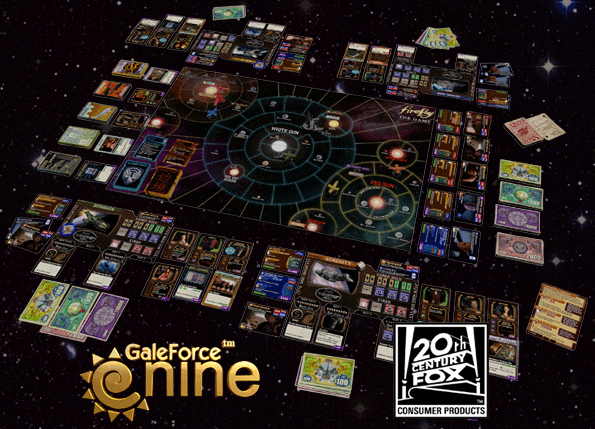
I picked up a copy of Gale Force Nine’s Firefly: The Game board game a week ago. I’ve yet to play it with others, but there is a “solo” option that I tried out. The game is nicely made, with high production values. There’s a board loosely based on the Quantum Mechanix Map of the Verse, five Firefly-class miniature pieces, a Reaver vessel, and an Alliance Cruiser; there’s a collection of different game card decks — this seems to be a new trend in board games, having a dozen decks of cards for things.

FireflyInProgress

Play is simple you take jobs from various contacts, try to do said assignments, and meet the requirements on a “story card” to win. Doing a quick trial as a solo, I found that the difficulty for some of the jobs require you not to just leap into misbehavin’ — but you want to get together a crew with the widest variety of skills you might need. There are some “short cuts” you can take — gear you need to pull off the job with ease (two words — “hacking rig”) or specific crew members. Resolving jobs has you roll a d6 — if you get Serenity, that counts as a six and you can roll again and add the amount.

It looks like it could be a lot of fun and the learning curve looks to be relatively low. The flavor of the show comes through very well in the game materials and play — Browncoats should love it. The game runs about $40 and I think it’s worth it, especially for Firefly fans. There are also a pair of card expansions for the game already available.

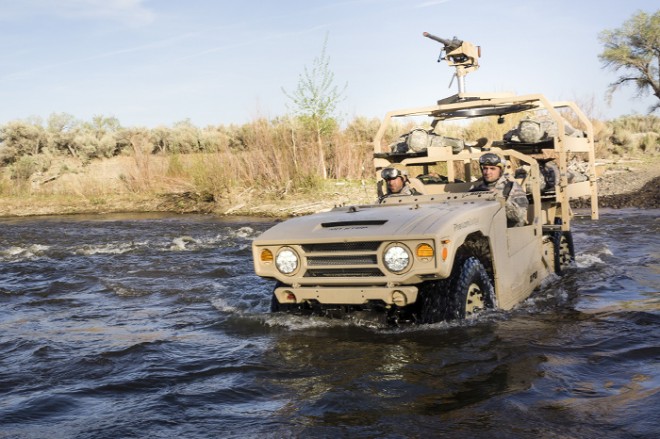
Phantom Badger Light Assault Vehicle

Photos_08_PhantomWorks_700x466-660x439

The US Navy needed a small, light combat vehicle for reconnaissance, rescue, or combat situations that could be dropped from the V-22 OSprey. What they got was the Phantom Badger by Boeing. It crams a 240hp multi-fuel motor and five personnel into a jeep-like chassis that is just 60 inches wide, barely 13 feet long and has a range of roughly 300 miles.

The Phantom Badger has four wheel drive and steering, allowing for incredibly tight turning radiuses, and can ford up to three foot deep waters, hit 80mph on a paved road, and has interchangeable parts with most other US military vehicles, as well as a modular rear deck that can be reconfigured with a simple wench set.

The craft can either use a .50 caliber M2A1 machinegun on the rollbar behind the driver’s compartment; and two M249 5.56mm SAW for the two rear-facing seats; or it can carry up to six litters for wounded. One can be carried in a V-22, two in a Chinook helicopter or C-130, and ten can fit in a C-17 transport.

PM: +1   RED: 4   CRUS: 50   MAX: 80   RNG: 300   FCE: 2   STR: 5   COST: n/a

GM Information: The Phantom Badger receives a +1EF for off-road conditions. In a roll-over crash, the passengers receive the same damage as the craft, rather than one WL lower.

Do you want a certain font from your computer on your iPad? Hit the App Store and search for Any Font. It’s a $1.99 app (last time i checked) that allows you to do just that. You can do a sync through iTune with it, but I tried loading a few .tff files into a folder on Dropbox, then opened them on the iPad. Dropbox, of course, can’t view them, but you “Open with…”, then choose AnyFont. The fonts appear in that app, you check them, hit install, and the app will bounce you through Safari to the Settings, where you will get a dialogue that looks a lot like the updater (probably is.) Install. Open up your Pages, or what have you and there’s your new font.

Is it worth $2? Do you need certain fonts to work with between your desktop, laptop, or what have you? Then yes. Otherwise…well, I’m gonna say “yes”, but I absolutely needed/wanted Bank Gothic on the iPad.

A few months back I did a review of the initial “beta” release of the new Firefly role playing game by Margaret Weiss Productions. The physical book is yet to arrive, but the .pdf went on sale a few days ago. I’ve gotten a copy of the game and just finished perusing it. So…review time!

The electronic book is 367 pages (including two for the covers) and is $19.99  on DriveThruRPG.com . As I expect from MWP, the art direction, layout, and overall look of the book is superb: full-color with a nice sepia-toned page color that evokes old paper, yet has tabs that give it a more modern flavor. The font will be great in print, but the serif is a bit difficult to read on the iPad’s screen (non-Retina) for my LASIK-modified, slightly farsighted eyes. Most of the art is either screencaps from Firefly episodes, or photos of models in appropriate clothing, etc. The text box sidebars occasionally get a bit busy. The weakest link in the art direction is with the character archetype pages, where the standard quality of RPG artwork reigns. It’s not terrible, but when compared to the original photo material, it stands out as anachronistic.

There is an excellent episode guide to the series that acts as a framework for presenting NPCs (or GMCs, as the game refers to them), spacecraft, and other episode-specific items. There’s an almanac to the ‘Verse that utilizes what looks to be the Quantum Mechanix Map of the Verse.

The rules set is very similar to the excellent Marvel Heroic Roleplaying that the jerks at Marvel pulled the plug on — in other words, a fusion of FATE and Cortex. For those who have played FATE, it will be mostly familiar, except for the use of standard polyhedral dice (d4-d12, no d20) rather than Fate Dice. The characters have three attributes: Mental, Physical, and Social, they have distinctions similar to the aspects of Fate, and skills from d4 (untrained) to d12. You put together a dice pool of applicable attributes, distinctions, and skills (plus other dice with use of distinctions and plot points, etc.) Ships or other vehicles of significance also have similar stats and are built almost the same way.

The mechanic is player dice pool vs. a game master dice pool that is either based on the same elements for the GMCs, or on a scene difficulty (d4 to d12) and any scene distinctions, assets, or complications. The GM decides what the stakes are in a test, or in combat a defender chooses the outcome. It’s easy enough to get a hold on the basics, but some of my players have found the ability to basically do whatever you can explain/pay for with plot points adds “too many moving parts” and makes it difficult to track what is going on.  While I don’t find it that complicated, I can see where — especially for new players and GMs — the looseness of the rules might be confusing. As with MHR, Firefly might benefit from GMs ignoring a lot of what you can do with plot points and “Big Damn Hero” dice, etc…

The appendix has a Chinese glossary to help players achieve the appropriate feel of the ‘Verse, as well as a master distinctions list to help build a character. There’s a schematic of Serenity (which looks to be based on the Quantum Mechanix material, as well), with close ups of her control console and engine, as well as the Maps of the ‘Verse. Lastly, there are interactive character and ship ships you can modify and save. (There are also free sheets on Drive Thru.)

Substance: 5 out of 5 — the book covers the series very well, has a complete rules set that doesn’t require any splatbooks (though I’m sure they’re coming…) Style: 4 out of 5 — the writing has the folksy tone of the show, and this might bother some (but I doubt it will the target demographic), the page design is mostly great but can be a bit busy here and there, and the character archetype and example artwork is sub-par compared to the rest of the book, otherwise it would be a 5 out of 5.

So…is it worth $19.99? If you are going to buy the book, no; go through MWP and order up the physical book/pdf combo. If you just want the e-book, yes — it’s worth it.

At some point in the near future, I’m hoping to do an alpha/beta test and run the same one-shot using this rule set, then the original Cortex rules from Serenity, then give a better comparison review.


Looks like the .pdf version of Firefly has dropped, which means the physical copies of the book should be getting printed soon. That puts it on target for the early June date that Amazon is showing.

Here are a few special-operations weapons for your James bond:007 RPG campaign…

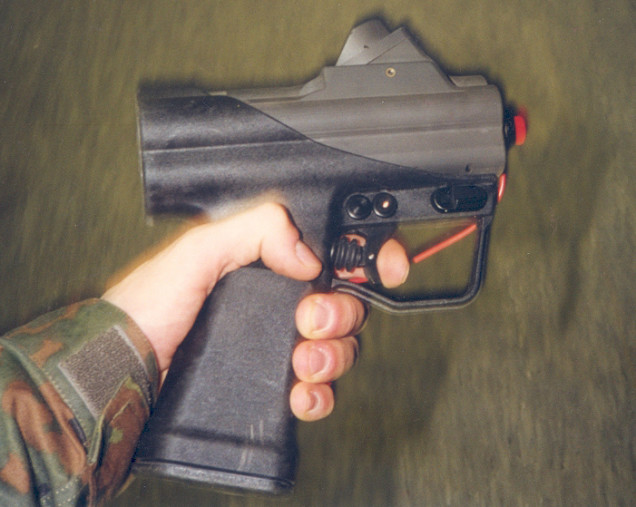
HECKLER & KOCH P11 Underwater Pistol

p11Developed in the 1970s, the P11 is a bulky weapon for use by combat divers. It uses five battery-ignited sold rocket propelled 7.62x100mm darts, each in their own barrel. The weapon cannot be reloaded by the operator, but must be returned to H&K. The range of the weapon varies according to the depth of the operator, and is only good for 100 feet or so in air.

PM: 0   S/R: 1   AMMO: 5   DC: G   CLOS: 0-1   LONG: 6-10   CON: +1   JAM: 98+   DRAW: -1   RL: n/a

GM Information: The P11 has a PM: -2 and ranges of CLOS: 0-2 and LONG: 4-10 in the atmosphere. For every 20′ depth after the first, the LONG: range decreases by one. Once the lower rating of long range is equal to close, all shots are long range.

On the Russian side of the fence:

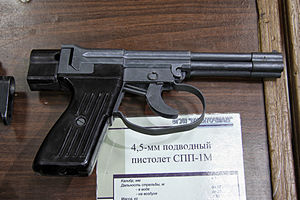
SPP-1 Underwater Pistol

300px-SPP-1M

Made by TOZ (Tulsky Oruzheiny Zavod) in 1971, the SPP-1 fires 4.5x40mmR steel darts each in one of the four barrels of the pistol. Unlike the P11, the SPP-1 has a break-open action allowing the operator to reload the weapon. The barrels are smooth-bored and use hydrostatic effects to stabilize the round; in the air, the weapon is highly inaccurate.

PM: 0   S/R: 2   AMMO: 4   DC: F   CLOS: 0-1   LONG: 4-8   CON: +1   JAM: 94+ (98+ for M version)   DRAW: -1   RL: 4

GM Information: The SPP-1 has a PM: -2 and ranges of CLOS: 0-1 and LONG: 4-6 in the atmosphere. For every 20′ depth after the first, the LONG: range decreases by one. Once the lower rating of long range is equal to close, all shots are long range.

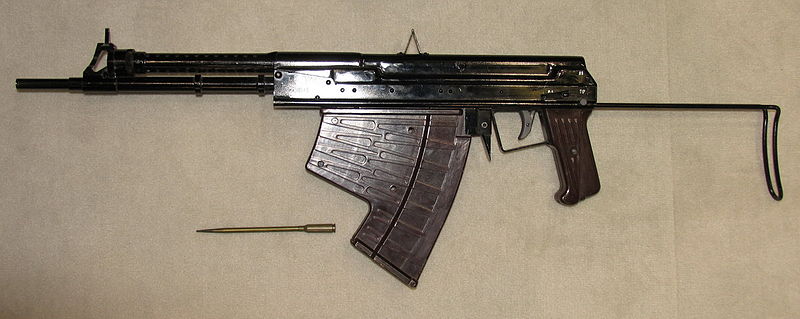
APS 5.66×39mm MPS Underwater Assault Rifle

800px-APS_underwater_rifle_REMOV

The APS was specially designed for Russian combat divers and uses a proprietary 5.66mm round that fires a steel dart from a specialized rifle casing. The gun is a smoothbore and uses hydrodynamics to stabilize the round. Out of the water, it is inaccurate, short-ranged, and without the buffering effect of water in the action, sees a dramatic rise in wear from use.

PM: 0   S/R: 2/6   AMMO: 26   DC: H/J   CLOS: 0-2   LONG: 6-10   CON: n/a   JAM: 93+  DRAW: -3   RL: 2

GM Information: The APS has a PM: -1 and ranges of CLOS: 0-1 and LONG: 6-15 in the atmosphere. For every 20′ depth after the first, the LONG: range decreases by one. Once the lower rating of long range is equal to 2, all shots are long range. Used in air, the APS has a JAM of 90+, but the action is rendered useless on a jam and cannot be repaired in the field.

And the newest entry by the Russian military is the:

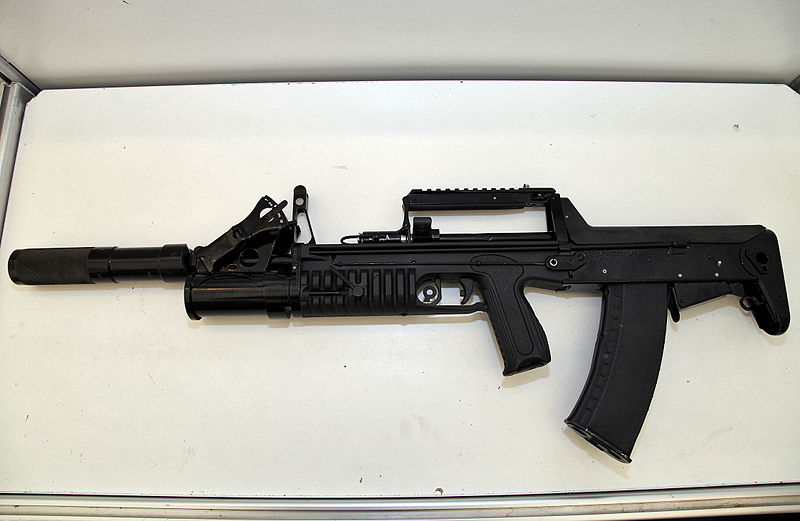
ADS 5.45mm Amphibious Rifle

800px-5.45mm_ADS_rifle_-_InnovationDay2013part1-44

Designed to overcome the inherent issues of an underwater weapon, the ADS was designed to be used in water or in the air, using a standard AK-74 magazine for 5.4rx39mm ammunition. Spetnatz and combat divers need to carry two different types of ammunition (the 5.45x39mm PSP for underwater, and any of the standard 5.45mm on land) to use the weapon, but the action does not suffer damage as the old APS did, and the effectiveness of the weapon is retained on land.

PM: 0   S/R: 2/10   AMMO: 30   CLOS: 0-20   LONG: 40-90   CON: n/a   JAM: 98+   DRAW: -3   RL: 2

GM Information: the range of the ADS is CLOS: 0-4 and LONG: 7-14 in the water, with -1 to the LONG range for every 30′ below the first. When the lower number of the LONG range reaches 4, all shots are long range.

For the VOG-25 40mm grenades used in the launcher:

PM: 0   S/R: 1/2   AMMO: 1   DC: J (area)   CLOS: 0-30   LONG: 40-120   CON: n/a   JAM: 99   DRAW: -3   RL: 1

James Kerwin brings us an updated look at Čapek’s fictional world: