Not a lot happened in our Battlestar Galactica game this week…or so it seemed. The “episode” was entitled “Mission Shift” and dealt primarily with the changing of several officers in the command staff and preparing for their next mission — planning and executing Operation Undertow, an attempt to collect intelligence on the Cylons in the wake of discovering they have cybernetically-augmented human agents (or possibly some new biomechanical Cylon?)

What they’ve learned: these agents are similar to humans in appearance and biology. Their DNA reads as normal. However, the blood contains molecular-sized machines, the purpose for which they haven’t ascertained. A fiber optic-like network was suffused in the brain and nervous system of the one agent, tying together into what they think was a central processing unit near the brainstem. There was some kind of heavily shielded superconductive liquid housed near the pineal gland — purpose unknown. The intelligence corps cannot decide if these are some kind of biomechanical Cylon, or humans augmented to be more pliant.

They have begged a scanning electron microscope to do the work needed to locate the nanobots, although a biopsy of the nervous tissue run through a spectroscope can also give a good indication of whether or not a person has been altered (or is a Cylon…) This information is still highly classified and the likelihood of a Colonies-wide test for Cylon agents is so politically toxic the fleet hasn’t even thought to suggest it.

Undertow’s current mission is to investigate systems with likely sources of tylium, radioactives, and other materials necessary for building Cylon and basestars. One of their vessels is the battlestar Valkyrie under William Adama (this is a version of the mission where Bulldog goes missing.)

I’m thinking about opening another front on the campaign, having the group play a second set of civilian or civilan and military counterintelligence characters investigating possible Cylon incursions on the Colonies.

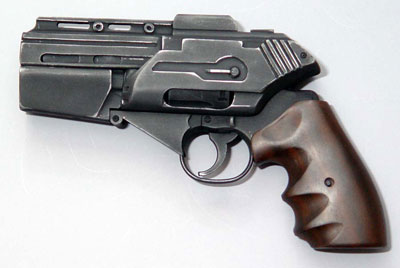
This is the pistol from the miniseries and season 1 of Battlestar Galactica. The producers wanted a futuristic-looking handgun, but one recognizable as a firearm not a laser. The “Colonial clamshell” as David Eick called it, was a Smith & Wesson 686 .357 magnum dressed up to look like some kind of autoloader, and had an underbarrel rocket/grenade launcher like on the FN57s they used later. (The reason for the switch was that the original pistol was barely functional and had to be broken down to be reloaded; the FN allowed for more realistic action, looked futuristic, and allowed them to burn up the huge 5.7x28mm blanks stores SciFi had from Stargate: SG1. So, going off of the basics, here’s my take on the CAL “Warrior” pistol:

CAL “WARRIOR” .36 magnum

At the beginning of the Cylon War it was obvious that the heavily armored centurions required more firepower than most traditional sidearms of the various colonies could provide. Most were almost underpowered for humans, much less killing machines — 5.7mm, 9mm, .45…  Various weapons were employed by the Colonial Fleet for the first half of the war but two pistols surfaced as the main sidearm for pilots — the Warrior by CAL of Caprica.

The Warrior is an electronic fired, magnetic-assisted .36 magnum which fires a 170 grain bullet at close to 1400fps by the time it leaves the barrel. The bullets are steel-cored with a hard tungsten tip that makes the round highly effective against hard armored target, and which would cause the bullet to break apart explosively in the target. A underbarrel single-shot 10mm rocket launcher was added quickly to provide a bit more punch when the .36 was ineffective — a system that translated to the new Picon 5-7, currently the main service pistol.

The Warriors were very powerful, but finicky weapons with a complicated loading gate system that allowed for six shots, which would then have to be unloaded through the same gate, one round at a time.

CAL “Warrior” .36 magnum   Type: Revolver   Damage: d10W (Special: 1/2 Armor ratings)  Ammo: 6   Range: 15 yards (Rocket launcher, 10mm minirocket   Type: breechload   Damage: d2d6W (1/2 armor ratings)   Ammo: 1   Range: 20 yards)


My “big drive” — a 2Tb Western Digital that I use to store our media library went sideways on my Friday, locking up while doing a simple shift of a video from movie to TV show category (thanks, iTunes; I know you were the culprit!) I could read, but not write to the drive and the Mac Air could not repair the drive.

As a result, I bought the Seagate GoFlex Home 2Tb network drive from Best Buy for $150. It’s an all-black unit that plugs into the networking base, which then plugs into the back of your router. Setup was simple, once I realized the drive was just not going to let me set it up without the Seagate software. I hate the way these companies set up the folders, and you can rarely mess with the higher level folders. Same issue here — I’ve got all these “GoFlex Public” and “GoFlex Private” folders. I’ll live with it because there’s a benefit — you can use their GoFlex Access app on your iPad to access the information from the drive via wifi, or through the internet (I’ve yet to try this, but the next trip to the coffee shop, I’ll experiment…)

Transfer speeds from the Air were very fast, the drive has functions, so far, flawlessly, and I was able to back up almost all of the iTunes library before the old Big Drive took a dump and had to finally be reformatted. I’m going to use the former for my Time Machine backups (as well as another disk) and to hold the iTunes library for my Air when it’s plugged in at home, but depending on how well the laptop and iPad can access the media through the internet, I may eventually ditch it or use it as a secondary backup for the media library.

My main concern about the drive is the same as the main benefit: it’s on the internet. Someone could , potentially, locate and crack the drive. The other issue is the Gestapo tactics of the RIAA and MPAA, and their minions in the Department of Homeland Security. These copyright trolls have been working hard to find any excuse to limit our free and fair use of media we’ve already bought form them in the name of preventing piracy (which studies repeated show do not impact sales, save to drive them up — it’s advertisement, like a radio station.)

If it doesn’t crap out like the WD drive, it’ll definitely be worth the $150.

After a year with Virgin Mobile, I noticed my el-cheapo Samsung phone was starting to give me issues with call quality and occasional signal degradation. Since they were firing up the iPhone on the network, I thought maybe switching to a smartphone would be a nice change of pace — especially as VM doesn’t bend you over and give you the ol’ English boarding school treatment, price-wise.

The iPhone turned out to be just a bit too much for the initial outlay to justify, even though I calculated it would save me about $1000 over a two-year contract with the Evil Red One or AT&T, both of which I’ve had service issues with. I decided to settle for an Android-powered phone, but which one? Their top of the line phone was $299…same issue as the iPhone, so I settled for the mid-range HTC One V. (Normally $199 on VM.)

First, the aesthetics: the phone is lovely. Like the iPhone, it’s got a solid Gorilla glass front and it seems to resist smudges pretty well. The main body is metal — aluminum is my guess — and that makes it very very sturdy. the other smartphones I’d looked at over at the local Best Buy were plastic and felt cheap or weak. There’s a power button at the top, a volume rocker on the right, power dongle attachment on the left side. Three buttons: back, home, and multitask (to allow you to scroll through or shutdown suspended apps. It’s very thin, light, and the shape and texture of the metal makes fit well in the hand and stay there.

20120707-233529.jpg

Fired up, it was just as pretty. The screen is bright and was very visible during daylight while i was out on the motorcycle today. Call quality is good, both receiving and sending, but in speakerphone mode is pretty pathetic; the Samsung was fantastic as in speaker mode.

20120707-234125.jpg

Setup was remarkably easy. Like most iOS devices, it came with a charged battery (about 60%.) Call the number on the back, enter the serial number and my phone number was transferred with no issue. Set up of email was a pain in the ass: my Comcast account still is not set up, but hitting the Play Store (formerly the Android Marketplace) allowed me to download the GMail app and my gmail account was up in seconds. Facebook also set up immediately, as did Twitter. I was able to learn how to change wallpaper and sounds with a bit of hunting about.

Uploading pics and updating Facebook and Twitter is a snap, email works well, and the internet comes through very quickly. Virgin Mobile uses Sprint’s network and I was getting the 3G signal icon while using the internet in a nearby small mountain town. Excellent! You can fire up wifi, if you want to avoid data charges. It looks like when it’s on a wifi node it uses that for data transfer. I haven’t tried Bluetooth yet.

Camera: it’s a 5MPxl camera and the resolution leaves a bit to be desired in lower light conditions. Outside, it took nice pictures — not iPhone quality, but better than the iPad 2 which took the above photos. I’ve yet to try the video recording, but it’s supposed to be 720P. The onboard memory looks to be about 1Gb, so I dropped a $10 8Gb micro-SD card into it. That should be plenty, since it is not my go-to data device.

Overall, I am very pleased with my purchase, and so far the upgrade to the better phone allows me to really use the free data, email, text of the Virgin network. (They do throttle you after about 2.5Gb of data…) All in a month-to-month plan that after taxes is still half what I paid for comparable service with Verizon or AT&T (You listening, guys? Of course not…)

UPDATE: After living with the One V for three days, I’m happy to say that battery life seems pretty good. I’ve been using Facebook and doing a few quick internet searches, email, the camera, texting a bit, and making a few dozen minutes of calls. I’ve still got a third to a quarter the battery.

Comcast contacted me about the email issue, but so far, no combination of settings allows for connection to the server. I’ve had similar issues with my iPad and laptop when traveling; certain wifi networks Comcast simply will not work with. If they weren’t the only real choice for high-speed internet in town, I’d dump them like I did their TV service.

The finale of Hannibal Drake and the Illuminati Treasure went off without too many hitches. Drake and McMahon, aided by Lord George Mace, the new Earl of Inversnaid — a man of some cunning and skill, himself — got into the Phoneix Club where one of the thugs from the last episode, Richard Edwards, is manager. Mace is convinced Edwards killed his father and wants revenge. He also wants to collect the treasure for the crown.

The Phoenix club is one part gentleman’s club, one part casino, and one part BDSM brothel — a descendent of the Hellfire Club. They manage to ascertain Edwards is on the premises, but while McMahon is being distracted by one of the “ladies”, Drake and Mace are being knocked around badly by the typical man-mountain thug. the fight included the bad guy throwing Drake across a 20 foot room and nearly through the second story window in one shot. he used the plinth of a statue to knock both men around, and in the end, it took the both of them pummeling on him to drop him.

Once they rescue McMahon from the killer lady of the night, they chase Edwards into the night and nearly get run over by his Bentley 8L limousine. They give chase in Mace’s Bentley 3 1/2 litre with sleek aluminum Rippon Brothers coachwork through Mayfair and Soho, then south to the Strand in the rain. They wound up on Wellington, just shy of the Waterloo Bridge, with the bigger Bentley having lost control and crashing. (Great, exciting chase sequence, this!)

They question the badly injured Edwards, find the location of the treasure, which he’s scheduled for the ahnenerbe agent and his thugs to take aboard the steamer Mary H. Mace gains the aid of the polie and they storm the pier. A firefight ensues in which Drake and McMahon grab a river pilot’s tug and give chase with Mary H. along the Thames, dodging currents and shipping. They finally manage to board the steamer and take it from the crew — mostly mooks.

Having gained the ship and the rest of the Illuminati treasure, and knowing Mace would turn it over to the Crown’s authorities, Drake has Jack take the steamer south to Calais to call in aid from the US embassy in Paris. They manage to arrange transport with the feds, and learn through Major Hall (still in London!) that US officials have tracked Ariel Smythe, the woman that double crossed them and probably killed Jack’s uncle, has landed in Lisbon, Portugal.

With the treasure safely on route to Washington and the their business in London done, Drake agrees to help McMahon track Smythe down in Portugal.

Next: Jack McMahon and the Spanish Civil War. Still only 10¢! On newsstands soon!

Colonial Military Equipment (Part 1): Spacecraft Equipment

The corebook covers the basics of Vipers and Raptors, and capital ships, but it was a first generation set of rules that never got cleaned up by Margaret Weis Publishing with the promised Colonial Military sourcebook. There’s a lot of wiggle room purposefully built in — this is not a combat simulation game; it’s a role playing game…but a bit of crunch might help with verisimilitude. So here goes…

In addition to the usual cannons and missiles that the light spacecraft of the Colonial Fleet employ, there are other important bits of gear that can save a pilot’s life:

Sparrows and Jiggers

“Sparrows” are the name of flare packages that both Vipers and Raptors employ for their protection. Designed to confuse and lure a missile away from their intended target, they use intense heat and visible light to combat an infrared or optical lock-on.

In game terms, a sparrow gives the pilot an opportunity (as an additional action to or replacement action for evasion) to roll a INTELLIGENCE+TECHNICAL ENGINEERING/ELECTRONIC WARFARE test. If they can beat the original gunnery roll of the enemy craft, the sparrow lures off the missile.

Jiggers are special chaff packages that shred themselves as they are launched, creating interference, and can be used to distract DRADIS-seeking missiles. In game terms, there’s very little difference between the two, but the GM could use IR vs. DRADIS missiles to give a bit more sense of realism.

Vipers typically carry two of each in the undercarriage of their vehicle, back near the engines. Raptors carry six of each.

Electronic Warfare

A new specialty for characters is Technical Engineering/Electronic Warfare. The characters use this to detect signals (SIGINT) and electronic emissions (ELINT.) The characters can do things with this skill like identify the EM or jump signature of a vessel, tell if the ship is under power or not, the temperature aboard, electronic activity that would allow anti-radiation missiles to lock on to the craft. They can also use it to identify open data ports and use the vessel’s communications to try and gain access to the vessel’s computer. (This requires a successful HARD Electronic Warfare test and a Hacking test vs. the INT+WIL of the ship, or the ALERTNESS+TECH ENGINEERING/COMMUNICATIONS or ELECTRONIC WARFARE of the target vessel’s communications or data control officer. Not all vessels have open ports, or they are only open during communications.)

The other use for Electronic Warfare is to jam communications, missile systems, etc. This is difficult, depending on the range to target, their shielding, and the frequencies covered.) In combat, jamming operations will often disturb friendly, as well as enemy communications unless the raptor’s ECO (or vessels EW specialists) can fix on the proper frequencies — a HARD  ALERTNESS+TECH ENGINEERING/COMMUNICATIONS or EW test. Once located, they can attempt to jam communications (thus rendering any benefits from a command and control element ineffective.)

Example: One Nite is the EW bird for a skirmish between Eagle Squadron and the Cylons. Her ECO, Drippy, has managed to isolate the Cylons’ communications (coded, of course and nearly impossible to break.) She takes over and attempts to jam Cylon communications and succeeds. Until they can re-establish communications, the Cylon squadron commander can no longer coordinate attacks, giving Eagle Squadron initiative each turn until the jamming stops or rendered ineffective.

There’s a problem with jamming — the jamming vessel is often completely blinded to incoming communications and can have their DRADIS array likewise jammed. They are also the brightest EM signature on the battlefield. While jamming, any unit targeting them gets a +2 shift to their PILOT or HEAVY WEAPON test to shoot the raptor.

This makes raptors a much more important part of the battlefield in a Batlestar Galactica game; they can easily turn the tide, as much as a Viper.

Decoys, Jammers, and other EW Weapons

During the rescue of the Colonials from New Caprica, we see the raptors use a new weapon they had not in other episodes — decoys. These are essentially missiles that are programmed to send out an signature that approximates another vessel. It hammers out an electromagnetic signal that creates a DRADIS “reflection” and associated signals to confuse the enemy. They are only truly effective in environments where DRADIS and other sensors are suffering from interference — as in a nebula, the heliopause of a planet, etc. They are programmed by the ECO using INTELLIGENCE+TECH ENGINEERING/ELECTRONIC WARFARE. The ruse is discovered if the enemy beats the result with an ALERTNESS+PERCEPTION or ELECTRONIC WARFARE test. Each turn, the enemy gains a +1 shift to their skill die.

Similar are jammers — missiles that are packed with high-powered transmitters that create havoc on the electronic battlefield, much like jamming operations for a ship. The missiles are fast moving and can be programmed to run a straight line or a shifting course. They will act on missiles, DRADIS, and communications within skirmish range and operate for up to an hour.

Lastly, there are EMP generators. These large pulse coils send out a massive burst of electromagnetic energy that is designed to stun or disable electronic-controlled enemies (i.e., Cylons.) They have a range of skirmish and will effect any Cylons aboard a ship, or within range. Most vessels are hardened against the effects, but it is very effect against the centurions (due to scaling.) They do planetcraft-scale d8W. The downside, since they are often mounted inside a vessel as a last-ditch defense against boarding elements, the effects are felt by the firing vessel, as well.

(Lee Adama used one of these arrays, slaving it to the FTL drive to make it appear that a nuclear weapon had detonated and destroyed Colonial One. The EMP generator would have done d12S damage slaved to the FTL with a range of capital. Using the FTL to boost the signal apparently caused stun damage to the crew of Colonial One, as well.)

Missile Guidance

As with the rules for sparrows and jiggers, missiles might be IR, optical/laser guided, DRADIS, or anti-radiation homing. In practical terms, in space, none of this is going to matter too much. There’s a lot of open space and not a lot to distract a missile. But as with the sparow/jiggers, the GM might want the pilots to specify their load-out for a mission. One way to do this is if there is a specific target — say, a transmitter tower of a Cylon outpost — might make using anti-radiation missiles more effective (a +1 or +2 shift to their PILOT or HEAVY WEAPON test to hit the place. Then it might matter that the Cylon raiders aren’t excellent radiation sources, their stealthy hulls providing a -1 shift to the same to hit them with the missiles.

The Big Guns

Capital ships’ weapons are pretty hazily defined in the BSG RPG. We know their range and their scale for sure, but what about the number of guns that can come to bear? Partly, this could accounted for by having the commanding officer do an AVERAGE INTELLIGENCE or ALERTNESS+PERCEPTION/TACTICS test and give the gunnery crews a +1 shift to their skill for every three over the result. This would represent the number of batteries that could be brought to bear on a target. Step the CO’s difficulty up a level for each target they are trying to engage.

How much damage to the guns do?

There’s Table 6.4 on page 133 of the rulebook. This applies to vehicle/planetcraft scale — light weapons would be wepaons designed for vehicle defense against personnel, medium would be standard armaments, and heavy would be something akin to the 130mm cannon that a modern-day AC130 carries.

For point defense, typical AA guns and 40mm autocannons would be “heavy” (d12W damage), with medium being slower-fire guns like .50 machineguns. Light would be the equivalent of a battery of squad assault weapons trained on a vessel…they can do damage, but it might take a while to drop a marine landing shuttle.

At the spacecraft scale, we are talking about massive AA guns that explode and do flak damage to larger craft. We haven’t seen this in the show; they use their railguns for that, but there’s no reason your campaign couldn’t have some sort of dedicated battery of cannon/railgun that serve the purpose.

Railgun damage is covered on page 134 of the rulebook in Table 6.5. What kinds of cannons would vessels have? Figure for small vessels — tenders, medical ships, and other transports, they have light railguns. They need the space for other equipment and cargo. this would be the typical “defense” gun a civilian vessel might have gotten a license for.

Medium railguns would be typical on gunstars and light battlestars like Valkyrie. Once again, there could be volume issues for the magazines causing them to favor the lighter weaponry, or perhaps if they were built during a time where the Cylons were not viewed as the main threat, heavy cannons are considered overkill against pirates and smugglers. they also might be cheaper…you have to figure a battlestar is an expensive piece of equipment, and the government would save money wherever they could.

Heavy railguns are the stuff of main line battlestars.

Missile payloads aren’t always going to be the biggest baddest available. You don’t use a MOAB for a surgical strike, for instance… Light missiles on a light craft would be the equivalent of a TOW pod — something to use against small, lightly armored vehicles when in air support mode. For light missiles, give the pilots a benefit that works to use them — they provide a larger area of effect, say, than a heavier missile, as a light missile pod shoots multiple warheads at the same time. Medium missiles, of course, are the typical combat warheads, and heavy would be large anti-structure weapons designed to destroy buildings and the like.

Spacecraft scale missiles start with light — these would be typical anti-ship missiles carried by fighters. They are small in size, but big in bang. (Think a Martel or Exocet.) Medium missiles would be cannon-fired missiles, essentially guided railgun payloads capable of tracking a target. Heavy missiles would have their own dedicated silos or have to be fired from dedicated railgun batteries. These could also represent low-yield nuclear missiles (below, say, 1 MTn.) In addition to anti-spacecraft duty, they would be used for ground bombardment. Extreme would be the equivalent of 1Mtn+ fuel-air bombs (unusable in space) and nuclear payloads.

Nuclear Bombs in Atmosphere

Nuclear bombs are not especially devastating in space. Spacecraft are shielded against radiation, there is no atmosphere to create pressure waves. But planetside, in an atmosphere — BAD.

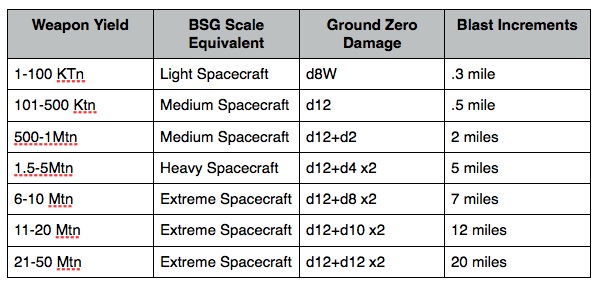
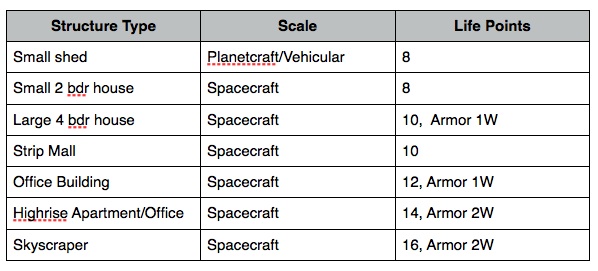
Here’s the damage caused by atomic/nuclear/thermobaric weapons. For each blast increment, half the damage (example: the Cylon use a 1 Mtn weapon on Caprica City. The damage rolled is 11. Every structure takes 11 points [usually enough to destroy most buildings] and vehicles 110, people dead if not in shelters… At 3 miles, the damage is 5 [round down] to structures — larger buildings will be severely damaged.)
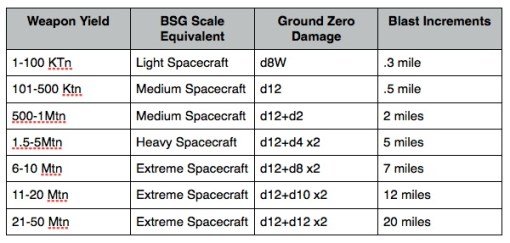
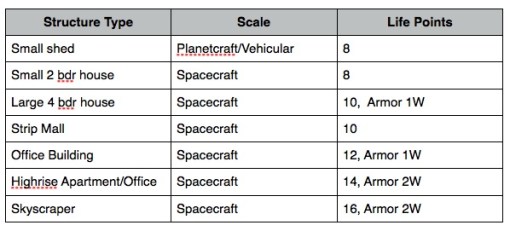
 And because you need an idea of what you can destroy in game…
There was some debate during one of the play sessions about skill levels that weren’t expert or master for characters. You might not be a combat expert, for instance, but might’ve had some martial arts training…what die do you get? How about unskilled folks?

Looking over the rules and the mooks/crowds templates, I noticed that “normals” have a d4/6/8 for affiliations. d4 is the lowest die used by Marvel, so for action tests where the character may only have 2dx for their pool, but some inkling of a specialty (you fight crime but don’t have a combat expert…you’ve at least picked up some kind of experience) they get a d4 for their pool if they don’t have the plot point to buy a d6. If they are “trained” but not experts — you can specify that at character creation and get a d6 in the specialty.


Born 21 August, 1910, Jack is the second of six children to Michael McMahon — an influential ward boss and alderman in Manhattan’s Bowery — and his wife, Megan.  His grandfather Thomas, the man who made the family’s fortunes died on RMS Titanic in 1911.  His uncle Robert was tied to bootleggers in northern New York (an open secret) and his uncle Patrick jumped to his death after losing his shirt on real estate speculation and the stock market crash in 1929.  Despite the family’s misfortunes, Jack is an incredibly lucky man.

Jack is handsome, strapping and athletic, and has the depth of a greeting card.  Raised in Manhattan with money, Jack is a city guy with friends and connections throughout the Big Apple, Saratoga, and Washington DC.  He went to private school in Connecticut, where he played basketball (the quintessential white kid’s game), football, baseball, and took boxing lessons.  He attended Columbia University for law, barely graduating with a minor in booze and babes.  His slick personality and charm got him through school, but he hasn’t yet passed the bar.

Living the life of a playboy, Jack is wealthy, but the money’s not as plentiful as it used to be.  His trust fund brings in a respectable $300/mo., he has a Upper West Side apartment with a view of Central Park, and drives a 1935 Auburn 851SC Boattail Speedster (red, of course.)  He has been traveling around the world seeking adventure and dodging real work since graduating Columbia.

Jack has fought train robbers on the Union Pacific, battled ancient sorcerous foes and Chinese gangs in San Francisco, and has fallen in with the Green Gang in Shanghai, where he and former classmate Dr. Hannibal Drake have been exploring China whilst fighting Japanese spies, gangsters, secret monastic societies, and other dangers.

Jack has all the things necessary for a hero: a strong pair of fists, a decent skill with his limited edition Smith & Wesson Registered Magnum (RM#11) and his limited edition Winchester Model 1894 lever-action carbine — both in the new .357 magnum cartridge, and a boatload of style.  Charisma, good-looks, bravery and physique compensate for his mediocre wit and recklessness.  Despite his vapid nature, Jack is great company, a loyal friend, and good in a bar fight (he is Irish, after all…)

Archetype: Adveturer     Motivation: Escape (from the ordinary!)

Nationality: American   Date of Birth: 21 August, 1910   Place of Birth: Saratoga, NY, USA

Height: 6’   Weight: 220 lbs.   Hair: Black   Eyes: Brown

ATTRIBUTES: Body:  3   Dexterity: 3   Strength: 3   Charisma: 3, Intelligence: 2   Willpower: 2

Secondary Attributes: Move: 6   Perception: 4   Initiative: 5   Defense: 6   Stun: 3   Health: 7   Style: 6

RESOURCES AND TRAITS: Lucky 1: Can add +2 die to a test, 2x/session; Robust: added 2 to health at creation; Skill Mastery, Pilot: he is the king of air and sea (in his mind); Status: 1: +1 social tests in US, +2 in NYC; Totemic Weapon, Gladys: +2 if time to aim or 2x range or style pt. gives rapid shot; Tough: added 1 to body at creation; Wealth 1: $300/mo.

FLAWS: Danger Magnet:  Trouble finds you, as does a style point.; Impulsive: Doesn’t think things through…ever.; Not in the Face!: Vain.  Will guard moneymaker in a fight…; Overconfident: What could possibly go wrong..?; Sucker for a Dame:  Girl like Jack.  Girl Lead Jack By Nose.

LANGUAGES: English (native), French (awful), Latin (even worse)

SKILLS: Academics, Law 1/4, Athletics 3/6, Boxing 3/6, Bureaucracy 1/3, Con 3/6 (Seduction 7), Diplomacy 2/5, Drive 3/5, Firearms 3/6, Intimidation 2/5, Linguistics 1/3, Melee 1/4, Performance 1/4, Pilot 3/6, Ride 2/5, Stealth 2/5, Streetwise 2/5, Survival 1/3

WEAPONS: “Gladys” RM#11 Smith & Wesson .357 magnum, Winchester Model 1895 .357 magnum lever action rifle, Winchester M1912 pump-action 12 gauge with heat shield for barrel (copy of USMC issue trench gun.)

By request of one of the readers, here’s one of the character profile from our Hollow Earth Expedition campaign from about the time the game started in Summer 1936:

Born 23 May, 1904 in Hoboken, New Jersey to the curator of the New York Museum of Natural History, Dr. Thomas Drake, and schoolteacher Margaret (nee Singer) Drake, Hannibal is the oldest of two boys.  He was raised in suburban New Jersey, with a view of Manhattan from their family home.  He would frequently travel into the city with his father to the museum, or to see shows.  He was an athletic child, with a fantastic ear for accents and languages — he quickly picked up some of the local languages from the immigrant families in the neighbor, and was fluent in Italian by his teen years.

The museum trips and his fascination with dime novels and comics books as a lad honed a sense of adventure in the young Hannibal, and he was eager to get out into the world and make his mark as an explorer.  As a teen, he took an interest in motorcycles — cheap transportation that didn’t require him to ride the train or bus.  He helped Mr. Pritchard, the local mechanic with his motorcycle shop, eventually buying himself a 1921 Indian Scout that he only recently replaced with a 1930 Indian 101 Scout.

He attended Columbia University — his father’s alma mater — as a legacy admission and studied foreign languages, where earned a doctorate in languages and  archeology (the two had many of the same course requirements, allowing him to finish faster.)  He is a specialist in ancient Central Asia — ancient Chinese, Aryan, and Turkic civilizations.  His graduate advisor was Dr. Sydney Lowell — himself an expert in Middle Eastern and Central Asian cultures and histories.

His father lost quite a bit of money in the stock market in 1929, leaving the family fortunes — slim as they were — destroyed.  Hannibal had to finish his doctoral work by getting positions as a graduate assistant on digs in Egypt and in China until his graduation, and along the way picked up a few friends in the antiquities market.  He made extra money selling valuable trinkets to these people, enough to finish school and gain a reputation with some of the archeological community as a grave robber and scoundrel.  Dr. Lowell — himself old school when it came to having some of his finds make their way to museum and personal collections by shady avenues — stood by the young man.  His father is now dead of emphysema, and his mother is working away as a school teacher in Hoboken.  Hannibal has a small house a few doors down from his mother, a gift willed to him from his father.  Mr. Pritchard — the crotchety old mechanic — is still around, and is something of a father figure to Dr. Drake.

In 1934, Dr. Drake started traveling extensively on a grant from his new home as an adjunct professor of archeology at Columbia, a position he wouldn’t have gotten without the aid of Dr. Lowell. One of his quests was to find evidence of a mellified man — an old Middle Eastern legend. During a side gig in India, Drake managed to locate the body of Admiral He — the famed Chinese explorer from the 15th Century — and a copy of his papers.. (Drake is pretty sure the body and casket are very very good fakes, but he was able to get them for a song and sell in to the Chinese government as authetic.) This put him in the position to look into the Chinese connection to the mellified man.

Archetype: Explorer     Motivation: Money/Fame

Nationality: American     Date of Birth: 23 May 1904     Place of Birth: Hoboken, New Jersey, USA

Height: 5’10”     Weight: 190 lbs.    Age: 32     Hair: Dirty Blond     Eyes: Blue

ATTRIBUTES: Body: 3   Dexterity 2   Strength: 3    Charisma: 2   Intelligence: 3   Willpower: 3

Secondary Attributes: Size: 0   Move: 5   Perception: 6   Initiative: 5   Defense: 5   Stun: 3   Health: 6   Style: 4

RESOURCES & TRAITS: Contacts 2: Academia, Antiquities Dealers; Mentor 1: Dr. Lowell, Columbia University; Status 2: Professor of Research Archeology: +2 social tests (+4 academic circles); Skill Mastery: Academics — all academics specialties; Tough: +1 to body at creation

FLAWS: Curious: Style point when it comes into play; Single-Minded: He doesn’t give up, once he’s on the job.; Scoundrel: He’s not a criminal, but he’s disreputable: -2 to social tests with people who know his reputation.

LANGUAGES: English (native): Ancient Egyptian, French, German, Greek (includes ancient), Italian, Mandarin, Sanskrit

SKILLS:  Academics 3 /6, Athletics 2/5, Brawl 2/5, Bureaucracy 1/4, Con 2/4  (Seduction 5), Craft, Mechanics 1/4, Diplomacy 2/5, Drive 2/4 (Motorcycles 5), Firearms 2/4 (Pistol 5), Investigation 3/6 (Research 7), Larceny 1/3, Linguistics 4/7, Ride 2/4, Science, Geology 1/4, Stealth 2/4, Streetwise 2/4, Survival 1/4

WEAPONRY: Colt M1917 Army .45ACP Revolver