As the GM, I don’t have a character they can really talk about, but there are a few that seem to have caught their imagination. Most recently, that seems to be Olga — the Russian girl they lured away from the Rabinowitz gang in Istanbul. Olga is a Russian Jew who was apparently a plaything for the head of the Special Department of the GPU, and we later found out a sort of “psychic battery” for mind or magical powers. She is quiet and beautiful, but vicious with her knout.

They took to her after they rescued a mystic they had gotten information from in Istanbul. The older former leader of the Thule Society had been kidnapped by the SS, and the characters felt obligated to save him. n the course of this, Olga broke a man’s wrist with a deft swing of the knout (everyone else was using guns), and knocked another cold. Guns, apparently, weren’t as scary as a young woman breaking people with a length of heavy leather.

Our current Hollow Earth Expedition campaign has been belting along nicely with a good, fun pulp flavor, and while there were many good moments we’ve had, the most impressive — for me — that we saw from one of the player’s was Gustav Hassenfeldt, our scrupulously honest, moral big game hunter, finally lose his temper with the bad guys as two dozen of them swarmed in on our heroes while they were resting from an earlier attack at a plantation in India.

While the others were smartly arranging their defense of the building, Gus grabbed his trusty Griffin & Howe .375 magnum bolt-action and a handful of spare rounds, and race to the second floor, where he proceeded to pick off five of the offending COMINTERN agents in the space of two rounds (about 10 seconds.) Each shot was miraculously deadly — essentially headshots, done in near darkness, on running targets shooting back.

It was the first time that Gus had been able to really do his schtick through the entire campaign. He’d either been in first fights, or used a small handgun on offending giant creatures, but it was the sheer amount and speed of carnage he wrecked that was truly impressive.

This is a tricky one, for me. I’ve only gotten to “just play” a few times over the few years, and that was in a short lived, unfinished Wild Talents game (good game, terrible system.) In it, I played a Scottish telepath working for the big, oppressive superhero bureaucracy that ran the world. His ambition and skills led him to eventually work against this group, and it was looking like we might not quite pull off my intended coup when the game just sort of …stopped. A not uncommon thing for many campaigns.

There were a lot of good moments in the play, but nothing that really stood out for me. So looking out over all the gaming I’ve done, there are a few moments that stand out, and most of them were not mine…

The final battle in our high-school Dungeons & Dragons game, oh so many years ago, where my character kicked in the door to the main chamber of the Big Bad’s sanctum, only to be faced with hordes of minion bent on turning him into sausage, and turning tail with a aaaaaaaaah! that led them away so the other characters could get to the bad guy wihtout interruption.

That time my friend’s James Bond character managed to flip a Lamborghini Countach — no easy feat — in the middle of a chase sequence after a “are you sure you want to do that?” moment.

The moment our two main heroes were coopted by the supervillainess in our DC Heroes campaign in the late ’80s, and became the de facto secret police for the new European Empire.

The weird kid that was in my Space: 1889 game charging hordes of Oenotrian soldiers after running out of ammo shouting about how he would bring down the “might of the British Army”, only to get — predictably — slaughtered. (He would then claim to have been “haunted” by his character in a dream because he hadn’t been “given respect” by the other characters… At that point, I thought it best he take a break from gaming.)

Similarly, there was the time the bounty hunter in our Star Wars game was surrounded by stormtroopers and after being disarmed, asked them, “Do you want my hold out blaster?” to the groans of the other players.

Same campaign, that time our old jedi in a Star Wars game first went to the Dark Side and started speaking in a deep Shakespearean accent. He would later atone. Then go bad to the Dark. Then atone. He got to the point he had a lightsaber that would go from a lavender blade to a dark purple when he was having a case of the evils. Oh…and he collected chairs from every place. Those cool imperial chairs from the Death Star. Chairs from Stardestroyers. A stool. He had a warehouse of chairs he never used.

The Babylon 5 game I ran during my time in the army, where the one Starfury pilot got the insanely good roll on his pyrrhic run against an Earth Alliance Omega-class destroyer…and his shot damaged the rotation gears on the living habitat, immediately shredding the ship at the midline.

Or the fight between the 12 year old street urchin and a Chinese assassin in a hotel lobby in Shanghai in our 1936-set Hollow Earth Expedition game, where she used a luggage rollaway to defeat him, Jacky Chan style.

But my proudest moment, this year, would be that moment, temporarily playing one of the other player’s characters (he was away on work travel so I was running him as an NPC): Part of the group was being attacked by Indian communist agents in our Hollow Earth Expedition game. They were stopped by a “broken down” car acorss the road, then boxed in by two motorcycles, with gunmen riding pillion. The players took off in their Alvis Speed 20, knocking down a motorcycle, but Gus Hassenfeldt — the big game hunter I was playing — slid off the back of the car, took the gunman’s pistol, grabbed the bike, and rode it into another bad guy, then ordered the rest at gunpoint to lay down their arms, lie face down, and wait for the police. And rolled well enough they did it.

I thought I really captured the personality of the character as the player had portrayed him.

After decades of punching out good adventure scenarios that only see the light of day with my groups, and to a lesser extent the readers of this page, I decided to attempt to do more with these games than reminisce…

And so, Black Campbell Entertainment has gotten it’s federal and state business licenses, so we are officially in business! Right now, we’re concentrating on getting out a series of pulp-oriented game modules or adventures or whatever the hell we’re calling them these days.

The first is The White Apes of the Congo. This will be a 35ish page adventure book that will come in a few flavors — Ubiquity (Hollow Earth Expedition), Fate (Spirit of the Century), and Savage Worlds — with cover art by comic artist Bill Forster.

After that, we will have a 1936 spy adventure, and another set in Shanghai where the players are looking for a mystical, or cursed, MacGuffin.

Following these baby steps, we’re looking at period-specific setting books: 1930s Shanghai and Istanbul, noir Los Angeles, Victorian London… And in the offing, a modern espionage game.

We’re also working on a screenplay.

Stay tuned. Big changes coming sometime around October.

Last week, one of our players cancelled out and at the same time we had a guy sitting in for a session…what to do? Go with an NPC in the current adventure? (I had an idea that would dovetail in nicely…) Do a one-shot? Board games — I can recommend Thunderbirds for cooperative grops, and Xtronaut for competitive types. Have a movie night?

These are all good ideas when you have incessant scheduling problems (the downside of having a larger gaming group. This week, most likely, we’ll have another two players out — one’s at GenCon, one’s working. (I really need a new hobby…) So this week, the answer will most likely be board games or a movie night, depending on if the one player is stuck working.

Last week, the answer was a one-shot. I decided to do a backstory one-shot on one of the new characters in the ongoing Hollow Earth Expedition game, John Hunter. We’re alluded several times to his misadventures on a mysterious island being how he got wrapped up with the secret society, the Terra Arcanum. So, I decided to do a one-night story that would tell the tale and be done, in case the one guest player didn’t come back.

So — how to tell this story in a 3 hour block of time? Hollow Earth Expedition, while a quick-playing game system, isn’t quite slick enough, and I needed to give the players a bit more of the heavy-lifting for the story and background development. I turned to Atomic Robo. It’s the fastest, best-playing version of Fate, in my opinion, and character creation is slick and quick. Four players were crafted (for the most part) in under half an hour.

The first act/hour was introducing the characters in media res — staging a burglary on the Order of Prometheus, a secret organiation dedicated to unearthing and using ancient knowledge. One of the players was a history of ill-repute looking for Atlantis, and chasing the tale of a “vanishing island” in the Indian Ocean that a Roman traveler once identified as that mythic place. The Order has two maps — one by Marcus Maximus Tinto, said roman adventurer, and another by the only survivor of a shipwreck from 1900 that had the coordinates of the island (not shown on any map, of course.)

The other players are John Hunter, in 1926 he’s a “man who can get you anything” in Paris; a member of the Terra Arcanum who is supposedly a smuggler, and who is along for this ride to stop the revelation of the island’s position; and a skeptical geologist.

They steal the maps, do a brainstorming session to figure out where the island is, then the historian — who has “More money that sense” as an aspect, gets them a crappy tramp steamer they take from Marseilles to the island’s position. His calculation give them the most likely time the island will show, and sure enough, the isalnd arrives under a suddenly-forming storm, giant rogue waves that suck them into an inlet where they beach on the hulk of a WWI submarine.

They have limited time to explore — they don’t know how long the obviously volcanic island will stay “visible”, and they speculate that the place may be “hydraulic” in some fashion — the pressures from the ocean flor rising the island and lowering it periodically…but how are there plants and animal life, much of it from different geological eras, present? They follow trails inland in the increasingly bad weather and light, and eventually run into a native tribe that captures them in a big skirmish, dragging the historian and Arcanum agent to their villge, which is surrounded by a giant boma of thorn bushes and large bonfires.

A rescue attempt is put together by the geologist and Hunter, while the others ascertain from the natives — who speak a form of Sanskrit not heard since pre-Harrapan times! — that every generation or so, the island is pulled to another world, where sometimes the every-present sun sets.  The Hunter and the geologist stage a daring rescue that revolves around setting the boma on fire as a distraction, and using their lone Chicago Typewriter to lay down fire and scare or kill the native warriors with a spray of .45ACP.

They elude their pursuers, dodge massive creatures whose footfalls shake the ground, and escape to their steamer in time to set sail before the island disappears behind them.

We closed out the night with the Arcanum agent planning on recruiting as many of their valiant band as possible.

Scheduling getting you down? Maybe it’s time to do something different for a session or two. The one thing I’ve found over 30+ years of gaming: if you don’t meet regularly, forget campaigns…you won’t be able to keep the momentum and interest.

There have been a lot of good to great sessions over the last year of play, so it’s hard to choose a “best session” out of what has been an exemplary year of gaming. For me, the best session came in April, with the successful conclusion of our long-running Battlestar Galactica campaign.

The campaign was started back in 2011, after the collapse of the long-standing game group prior to that. That group had been, in various configurations, going since 2003, and after losing two of the core players, the rest of us cobbled the group back together for a phenomenal run of Hollow Earth Expedition and the start of BSG. It had begun as a “redo” — taking elements from the old game and improving on it. Over the next almost five years, we lost half of the group to Texas and other life changes, leaving me and one of the players from the original group to soldier on for a few months before we finally picked up the third regular member. Others came and went, but the trio of players — all really into the game — remained the new core.

The small number of players made scheduling easier and kept the game focused and on track. We increasingly diverged from the reimagined show, with more sci-fi elements in which the Lords of Kobol eventually played a much larger role in the story, and the motifs of cyclical time, recurring themes of self-destruction, loomed large. I had to tweak and twist, and roll with the players’ decisions, but in the end, the story ended very closely to what I had hoped for.

How often does that happen?

The story ended with the characters finding Earth, populated by the 13th Tribe. Happy ending…and we could have left it there, but I had always envisioned a coda to the game, that last episode that would put a bow on it. In that coda, we picked up 20 years later, at a Settlement Day celebration for the arrival of the rag-tag fleet and the creation of the Earth Allied Government. The players got to see their players, older, well-established in the politics of the new Earth, and the interstellar politics with the Lord of Kobol they had found, the survivors on the Twelve Colonies, and another group of colonies out by the Pleiades. It was a nice send-off for the players that had the same vibe as Babylon 5‘s “Sleeping in the Light” episode. (Exactly whatIi was hoping for…) After that, we had a short act where, 500 years later, the Pleiades Colonies were attacked by the machine soldiers of the “Olympians” (the descendants of the Lords of Kobol), who were looking to support the recently disgraced “Leader Baltar” starting the whole story over again.

To have a long-running campaign come in 1) completed (ho often does that happen!?!), and 2) finish the story fairly closely to what you intended is nearly unheard of. I had finished a less ambitious Babylon 5 game in 1999 that had been running for two years, but that had been much tighter to canon of the show, playing around the edges of the main story, rather than just striking out from the base conceit to do our own thing entirely.

For those reasons, that sessions was probably the best session of my entire gaming life.

For the first 2016 RPGaDay, the question is: Real dice, dice apps, or diceless — how do you roll?

This is a good question, as how to randomize was central to the design of the upcoming system for a game we’re working on at Black Campbell Entertainment. It’s not just do you use dice or apps or no, but what kinds of dice that interests me of late.

When Dungeons & Dragons hit in the late ’70s, the idea of different kinds of dice — not just the classic cube of old, but different Platonic shapes — was novel. Half the fun, I would propose, to D&D was rolling all these weird dice. Prior to that, some of the box sets had chits to randomize your actions. Roll a d20 — pick a chit from the “d20” pile; that was nowhere near as fun as throwing a d20.

Other games, like Traveler, right off the bat, tried to make themselves different by sticking to the d6. This was good in that 1) you usually had a set of these, somewhere; and 2) they were familiar. Using a pair or trio (as in GURPS) of d6s seemed “simpler”, even if the math was not. Some games looked to move to percentiles — using a pair of d10s to give you a flat distribution that was easy to grasp.

During the late ’80s up to the start of the new century, I tended to prefer these one type of die systems. I loved James Bond, but always wanted to shed the d6 for initiative. I liked West End’s d6 system for Star Wars…other than needed a wheelbarrow full of bones to have that Stardestroyer shoot. White Wolf used d10s. Easy, right? Who needs a half dozen types of dice!?! And there is something to be said for this approach. (There was also a certain “Get off my lawn” quality to thumbing my nose at how OGL d20 was invading every damned game put out about the turn of the century/millennium.)

But with the release of Cortex and Serenity in 2005, I found myself rolling different types of dice for the first time in decades. (I actually had to go buy a set of polyhedrons for my ex-wife; I was already using dice apps on my laptop.) There is a certain tactile delight to knowing you’re rolling a crappy trait or skill with a d4, or a great one with a d12. They sound different when they hit the table; they look different; they feel different — and that, for many gamers, is part of the experience. So much so that when I stated working on our game system, I found myself shifting away from the initial d100 mechanics that I had envisioned.

Because even on a dice app, rolling different dice is fun.

Which leads to the real question that was asked: How do you roll? I started using a laptop to run games and store my notes, etc. around 1997. For some games, if the system is easy enough, I use my iPad. One thing I like about going paperless was that I no longer had to tote books and notebooks and dice around. I could show up with my computer and go. (And since the battery technology has improved so much, I rarely have to even have a power cord.) I started using dice apps early on. This wasn’t so hard when we were playing the single dice systems of the ’90s, but returning to polyhedrons required being a bit more discriminating about my dice programs. There are plenty that will work with d20 games, but aren’t sophisticated enough to do multiple types or dice rolled together and added (or not.)

Since making the switch to a Macbook Air in 2010, my choices for a good dice app are even more reduced. Pretty much, the best I’ve found for my purposes is Dicy. It’s free. You don’t get a nice animated dice screen, like I do with Dicenomicon (you can find it in the app stores for iOS and Android) — which I have on my phone and iPad.

Dicy allows you to do some tweaking for presets and roll groups, but I’ve yet to use those. Having run Battlestar Galactica for five years (Cortex system), I just needed to add the dice together, and there’s a checkbox for that. There are a few on the MacUpdate site other than Dicy, but you might run into security issues when downloading them. Another that works well is Bones, which I downloaded, with others to look at for this piece. I was going to look at DiceBag X and Polymatic, but the MacUpdate wbsite now bundles crapware with their downloads unless you are a paid user so [expletive deleted] those guys. I tried Rock n Roll Dice — which I think was the one I used for PC, before the Air — but the Mac version didn’t work on my laptop. (Another I seem to remember using was DiceMage.)

Dicenomicon is a graphic dice roller for tablets and mobile phones; I wish they’d do an OSX version  and now they have it as an OSX app. You can find it for $2 in the App Store. You see/hear the dice roll, but you are limited to 10 dice total on the mobile version; the OSX version doesn’t have this limit. The mobile version can be customized, however, to roll just about any randomizer you can think of, including Fate dice, coin rolls, etc. It’s free. (Seeing a pattern?) The Mac version is currently limited to the usual d4 through d100. You cannot alter the background, just the dice colors. I hope this will be changing.

If you do most of your playing using a computer, tablet, or phone having a dice app is near-indispensible. It’s less to carry. It allows the GM to roll secretly, if needed. As a player, I tend to let the GM hold onto my character sheets for me, and all I bring is my phone (since I usually have it anyway) and there’s dice.

However, I understand the tactile delight of rolling physical dice, and I still do it, from time to time. As for diceless systems, I’ve not tried any outside of the half-assed “rock-paper-siccors” to randomize a game while traveling in a car, once.

So what about you? Dice? Apps? And do you have suggestions for the various platforms?
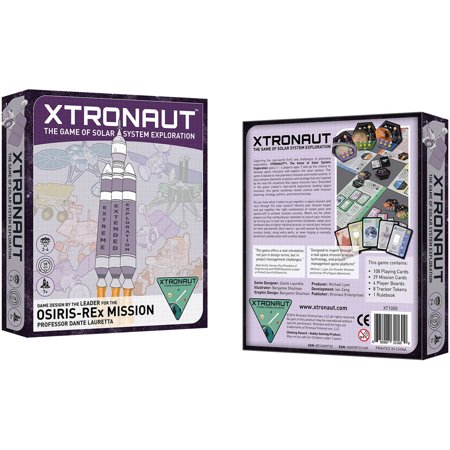
This was one I stumbled onto on Kickstarter — Dante Lauretta, an planetary scientist at University of Arizona and the head of the OSIRIS-REx mission, while doing the massive amounts of waiting that come with the space program, and some of the members of his team decided to build a game based on their experiences in rocketry. The game hit its goal with little issue, and arrived today, only a few months behind the initial expected date (which is pretty good for most Kickstarters.)

33450962-4b80-402e-8675-04de9a3b7a5f_1.89dac27ab5d77318512a8737744f1a48

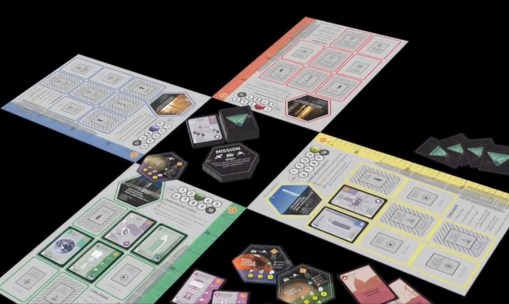
Xtronaut: The Game of Solar System Exploration is a board game for 2-4 players. Each player attempts to build a launch vehicle, choose a good payload for the mission they’ve drawn — be it a lander, orbiter, or rover — and attempt to get the necessary delta-v to reach their goal. Each mission gives you “data points”. Reach 10 data points first, and you win.

It’s a simple concept and execution, and has a nice educational aspect to it, which is why a bunch of education and space science-related groups have gone gaga for the game. But how is it as the game? Turns out, pretty good.

I tried two games with just myself and my five-year old daughter (the minimum suggested age is 7.) She was able to grasp the basic concept — pull a mission card that give you the necessary delta-v, and the number of data points received for the size of the spacecraft for the mission; build a launch vehicle with a first stage booster (and possibly extra boosters), a second stage lifter, the payload spacecraft, the fairings to protect the same, and using gravity assist. These elements are drawn from a player hand of five cards, drawn from a deck of cards that include other “action cards” that allow you to salvage parts (dig through the discard pile), draw extra cards, or financial audit another player to steal their cards. There are also cards where you lose pieces for “national security” (the result of the Air Force commandeering one of OSIRIS-REx’s boosters) and Government Shutdown. These add a nice sense of the bureaucracy surrounding trying to get your robot into space. The rocket you build and its mission go on a simple gameboard — one per player — where you track your build, your data points, and the delta-v you have. Once you have enough to go, you discard all the cards, draw a new mission, and start over (unless you have SpaceX’s Falcon booster…that’s reusable.)

160818-xtronaut-game-asteroid

The two-person game was fun, but adding another player really brings it to life. With the kiddo and wife, we had a very competitive game  that lasted about 45 minutes. We all really enjoyed the game and I’m hoping some of the stretch goals expansions hit the market soon.

Is it worth it? Oh, yeah.

Style: 3 out of 5. While the cards and boards look nice, and are purposefully simple in their graphics, the cards could have been of better stock. They’re a bit flimsy after the cards for the Thunderbirds game, but that’s hardly fair…Modiphius does superb production value on their stuff.

Substance: 5 out of 5 — the game is deceptively easy, but there’s a lot of strategy to it. Have a high energy mission? You really want NASA’s SLS booster system, but there are many cards for it, as it is still a rare launch platform. Want to get ahead for your next launch? SpaceX’s Falcon is the way to go. Maybe auditing that guy next to you to hopefully nab that Atlas second stage is a good idea. Maybe a trade for that right fairing is the way to go. the rules are simple; the game play can be hard.

It’s worth it.

Here’s the Xtronaut website highlighting space outreach and the OSIRIS-REx probe, and here’s the just-posted link to buy the game through Amazon.

Okay, I’ve loved my Thruxton since the first time I rode it on the Sandia Crest road here in New Mexico. (That’s a road about 10 miles long with a 120 turns, ranging from long sweepers, to good chicanes, to hard switchback, with an altitude climb of about a mile. It’s like PIke’s Peak, but less deadly.) I’ve ridden the hell out of Trixie — named for Speed Racer’s girlfriend — putting almost 30,000 miles on her in 4 years.

So, of course I’m interested in the new Thruxton, the green one which is now officially approved by my five-year old daughter:

13686660_10154376451392082_6440553930231374092_nSo at a birthday party for the 13th year of the local Triumph shop, I got to be the first to ride the white one behind her for about half an hour.

It’s powerful. It’s not Panigale or Aprilia sportbike powerful, but it’s easily pulling no punches. I popped the front tire up coming out of the parking lot into a right hand turn because I treated it like my old Thruxton.

Don’t do that.

The 1200cc water-cooled mill churns out 112 ft-lbs of torque at 4500rpm…which is right where it seems most comfortable. The 97hp hits about 6500. This thing moves. I was doing 60mph in second gear before i realized it. Getting it out onto old Route 66, I played with throttle response and it is sharp, brisk, and the bike wants to run. Normal secondary highway speeds are easily acquired in third or fourth gear. I only got into sixth on the interstate, where I got up to 115mph in a stretch with no traffic. At that point, the Thruxton got pretty light up front. I suspect the top end is somewhere close to the indicated 140. It does, however, get a bit finicky at 4500rpm, and feels like it can’t decide it it wants to go faster, or slower. It disappears if you back off a tad, or hit it just a bit harder. Fuel map, I suspect, and the fly-by-wire clutch.

Handling is very smooth, immediate, and the bike turns very well. The seating position is slightly forward, and my arms (I’m 5’9″, so averagey) drop straight to the bars, the pegs leave more legroom than my 2010, and I never got close to scraping anything. It’s about the same weight as my bike, but feels lighter; the weight must be lower.

The brakes are good. Not Ducati stop right now! great, but very quick and responsive, without the Ducati desire to have you do an Olympic-level sitting long jump.

So is it any good? No — it’s tremendous. It looks great, the clutch is very light, the bike does what you want when you want it, but no more — just like every Triumph, it’s polite. Is it worth $12k? Yes.

We started the evening with a flashback to Lady Zara sneaking back into her home with her Uncle Trevor waiting up. She’s just wrecked her new car racing in nighttime London. One of these days, he predicted, she and her fast friends were going to get into a situation they could not recover from…

That leads her to wake under a pile of bodies in the wreckage of the war saucer Aruna. Gus Hassenfedlt had already been awake for a while, triaging the dead and wounded from the crash. Of the 14 “Atlanteans”, only 8 survived, including Lord Amon and Shria, the pilot. The other characters were pretty banged up, and with Gould giving him instruction, Gus bandaged and treated most of the wounded, while the doctor tended to the party.

Afterward, Shria sounded the ship and found one of the “power crystals” that ran the motor that malfunctioned had shattered — she’s never seen anything like it! There’s damage to the forward propulsion units, as well. The ship isn’t going anywhere.

Gus, Hunter, and Amon set a watch around the saucer, only to aggressed by a herd or pack of allosaurus. In the fray, Hunter is badly injured, but Gus and the others in the fight manage to kill the four towering carnivores. At least now they have plenty to eat.

After a few days, they are discovered by a dozen people in riotous clothing — brightly colored (although the theme of white and red-striped canvas pants, shirts, etc. seems to recur) and adorned with bits of junk and widgets. Led by Zoppo, a brave but stupid man, they learn they are from “the Sanctuary” — only a day’s travel away on the coast. They had come to give offerings and the welcome the Atlanteans in their sky craft! Eventually, they discover they all speak English, the holy language of their “Captain.”

With no other options, they set out to find the Sanctuary, which turns out to be a settlement that adorns the sides of a wrecked two-stack ocean liner, the SS Grand Pacific. The front is opened like a toothed maw, the back is obviously broken, and there are boats tied around the keel. Overhead, a red and white-striped blimp is moored to one of the stacks.

But the real shocker is what’s out to see — a mountain of rock with a city on top, floating over the water. This, they learn from Amon, is the Aerie…the home of the “hawk people.”

Taken aboard Sanctuary, they meet the “Captain”, the last remaining crew member of the vessel, which launched from Liverpool for Melbourne in June 1893. Evan Hollander is the captain, and he is very pleased to receive the Vril/ Gould suddenly realizes they’ve been  played…these are not Atlanteans, but the people that the pirate king, Trihn, had tried to sell him to!

We left off for the night there, with the characters surrounded by cargo cultists, in their hulk of a home, and their Atlantean friends exposed as fakes.