So, tonight saw the culmination of the party’s attempts to find the Eye of Shambala, and the start of a new chapter in their adventures.

Having left off in Lhasa, Tibet, the team arrived a day after the Germans, led by Dr. Albert Heiser and Haupsturmfuhrer Werner. A tense dinner for the team is thrown by the village elders, and the Germans are (of course) invited. That evening, everyone has intense dreams — Gould dreams of a faceless creature calling to him, calling him son, and dreams of trackless red desert and lush, improbable jungle landscapes; Zara dreams of a particular encounter in Africa she had; Gus Hassenfeldt of losing him father (for a time) to the Great War…
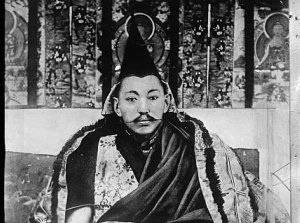
13thDalaiLama1910The next morning, they are taken to meet the 13th Dalai Lama, who is concerned and intrigued by the sudden arrive of people in airplanes, and intent on seeing the Eye — an artifact of great import, but one that has resisted their every effort to unlock its mysteries. Even the purest of heart cannot open the Eye. Gould admits that he did just this think in Africa. Only the Ancients could do this! He is a descendent of the people from the birthplace of the world!

Before they can get much further on this, Gould noticed a strange droning noise no one else does, sees shadows from the windows no one else does. Then all hell breaks loose — the monks warn the Dalai Lama that men have invaded the Potala Palace, and the sound of automatic gunfire comes from the city. It’s not the Nazis, Werner has no automatics! At that moment, an airship — SSSR-V6 — appears out of nowhere! At the same time, strange, ghostly things invade the audience chamber! (All the characters did well enough to sense these invaders, but only Gould could see them for what they were — Russian soliders, and two that held back, a man and a woman. He senses the pull of the man, the attempt to bend Gould’s perception with his will.

After having dropped hints about the Bekterev Brain Institute and Olga’s connection to the same, I thought it was time to up the ante…if you’re going to hint at Russian psychics, you give the audience Russian psychics. (Looking at you, George Lucas and Steven Speilberg!) The man, Arkady Lenshev is known as “the Ghost” and can make people and things disappear with the power of concentration; the girl, Galina Obreva, is a mind reader and mind controller.

Olga recognizes the misty figures and warns them it’s “Section 2!” Then the fight is on — Gus throws a heavy bronze vase at one of the figures and drops it, where it turns into a Russian soldier. Obreva takes over Werner before he can fire his PPK, and makes him take a shot at Gus. Before this can happen, however, Zara throws Rigoletto — her capuchin monkey — at the Nazi and throws off his aim. Hunter attempts to save Gould and gets into a fight with the stereotypical Russian man-mountain and doesn’t do so well.

Gould runs for it, gets out into the hallway only to be squared off with the Ghost, who is impressed — no one has ever seen through his cloak before. Gould fakes a surrender, gets close, and manages to get a knee in Lenshev’s soft and danglies. He’s just getting the Tokarev out of the man’s holster when a half dozen soldiers burst in.

The others are deep in a fight. Other Russian mist figures grab Olga, but Gus manages to get one off of her and choke him out. Olga is taken over by Galina and nearly busts Hunter’s head open with her knout, then is knocked unconscious by the monstrous, Ivan Drago-esque Russian soldier. Hunter struggles out his revolver and is about to take a shot, but is taken over by Galina for a moment (the plaer got an incredible Will roll!) and realizes it’s her trying to take him over. He is able to shoot the big Russian in the back.

The Russian backup arrives just in time to make things more complex. Zara, Gould, Hunter, and Werner gun down a bunch of the bad guys while retreating after the Dalai Lama and his monks. As they are making good their escape, Werner’s German troops show up and a gun fight ensues.

The characters escape, and led by the monks, get to the Dheva Cave where the Eye is held. Gould’s presence opens the eye, and his connection to it is even more powerful with Olga in proximity — it’s the first hint of why the Russians want her back: she is a focus for magic; her presence enhances the connection of magicians and magical objects to their source of power. The sounds of fighting move closer, and Gould grabs Olga and jumps through, with Hunter and the others following close.

On the other side, they arrive in a cave and startle a bunch of bats, which drives them out into the daylight. The characters find themselves in a hot, humid, and mountainous jungle. The air is thick, the sun small and incredibly bright, and around them are the grand ruins of an ancient city…Shambala or Shangri-la!?!

That was where we ended the night, with the characters finally having reached some exotic and unknown locale. The hollow earth? Some jungle on Earth? An alien world?
 

I needed a new talent that would work well with the new bad guy organization we introduced last week — the Special Department of the GPU. The group is in charge of the psychic and magical research of the Soviets, and one of the standard tropes of the period was the connection to sexual promiscuity in “sorcerers.”

To that end, I created the following. Feel free to use or alter it:

Magical Focus

The character is a repository of magical energy. Maybe they aren’t capable of using this energy themselves, but others can tap into it through a variety of methods — maybe they need their blood, maybe they need to touch the focus, or maybe there is some kind of tantric component. However it works, a sorcerer can add a +1 to their sorcery roll if they are able to gain access to the however the focus works.

The focus themselves can pass magical energy to the spellcaster by taking 2 non-lethal damage in exchange for +2 dice to the sorcery test.

Normal: The character has no special value to sorcerers.

Talent: See above. The magical focus talent can be taken up to two times.

A little tweaking was needed this week for one of the NPCs in our current campaign. Here’s the result…

Olga Markova

Born in Kiev, 6 June 1911, Olga was the second child of Samuel Markov and his wife, Rachel. Her brother, David, is two years older. Her parents were Jewish, and ran a successful tailors shop. Her father was lightly involved in socialist politics, but avoided trouble. With the Revolution in 1917, her father moved swiftly to join the local Soviet, and avoid becoming a target. Her father was a member of the Ministry for Jewish Affairs under the Ukrainian  People’s Republic, and once the Bolsheviks arrived in force, he quickly joined the Yevsektsiya — the Bolshevik organization designed to eradicate Jewish culture and Zionist movements — in 1921.

An ally of Trotsky, when the Yevsektsiya was disbanded in 1929, Samuel fell afoul of the new GPU. Her parents were executed, her older brother David was sent to one of the new “gulags” in Siberia. 17 year old Olga became the plaything of Mikhail Ruslan, one of the local GPU Special Department officers. From there things get strange, and a lot of hearsay surrounds her background.

Ruslan was a protege of Gelb Bokii, the head of the Special Department, who was a close ally to both Lenin and Dzerzinsky. In addition to running the work camps, Bokii frequently was tasked with strange, esoteric operations. One of those operations under his oversight was the Bekhterev Brain Institute, where experimentation on “psychometry” and other mental abilities was conducted. He also was in charge of missions to find objects of power, and to investigate the location of Hyperborea. Olga was frequently at the Brain Institute, and was supposedly “very important” to Alexandr Barchenko — the head of the BBI — and was a regular attendee of the orgiastic gatherings of the Special Department at the Kuchino dacha.

Eventually,  in early 1932, Olga contacted the Bosphorous Hebrew Relief Fund, leaking information that Ruslan and Barchenko would be in the Crimea. The Rabinowitz Group attempted to kill the two men, but missed, having been intercepted by GPU agents. Olga, however, killed Ruslan and injured Barchenko, before escaping with one of the Rabinowitz thugs. This earned her a ticket to Istanbul, where she has been working wth the group ever since.

Olga has quickly established herself as a competent spy and blood-thirsty assassin of Cheka agents. She even made an attempt on Trotsky, himself, but missed. Most people do not see her coming; she uses her good looks and aloof demeanor to draw in her targets. Among the Rabinowitz Group she has a powerful reputation for her absolute calm in tense situations, the collection of whip scars on her back, and her vicious use of a great knout when questioning enemies.

Recently, she and her companions have become aware that she is of great interest to the Special Department’s Section 2 — their “mystical” investigations unit — and that Bokii, himself, wants her returned unharmed. There are several theories as to why: 1) she is a latent psychic, 2) she has some kind of mystic competency, and most likely 3) she has captivated several of the men or the Special Department.

Archetype: Spy     Motivation: Revenge     Health: 5     Style: 5


Height: 5’8”     Weight: 110 lbs     Hair: Black     Eyes: Green     Age 22

ATTRIBUTES: Body: 2   Dexterity: 3   Strength: 2   Charisma: 3   Intelligence: 3    Willpower: 3

Secondary Attributes:  Size: 0   Move: 5   Perception: 6   Initiative: 6   Defense: 5   Stun: 2


RESOURCES & TALENTS: Attractive; Finesse Attack: Systema and Melee; Magical Aptitude; Magical Focus: Can act as power source and focus for other magicians

FLAWS: Callous, Criminal; Hunted, GPU and other occult groups

LANGUAGE: Russian & Yiddish (native), French, Hebrew

SKILLS: Acrobatics 1/4, Athletics 2/ 4, Con 2/ 5, Diplomacy 1 / 4, Firearms 2/ 5, Investigation 2/ 4, Language 2/ 4, Martial Arts, Systema 2/ 5, Melee 2/ 5, Performance, Acting 1/ 4, Stealth 2/ 5, Streetwise 1/ 4, Survival 1/ 3

WEAPONS:

Knout Damage: 1N   Rng: 8’   Rate: 1   Spd: A

Ithaca Field Gun 12 gauge, sawed-down: Damage: 4L   Attack Rating: 9 (4+)L    Rng: 25’

Cap: 2   Rate: M   Spd: A

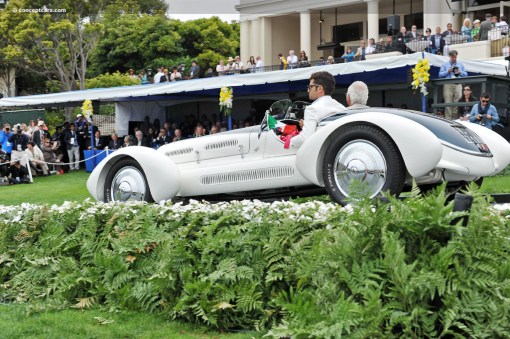
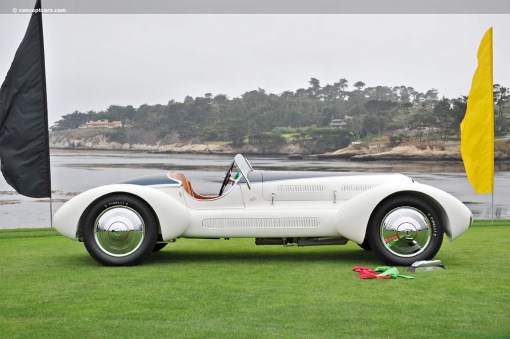
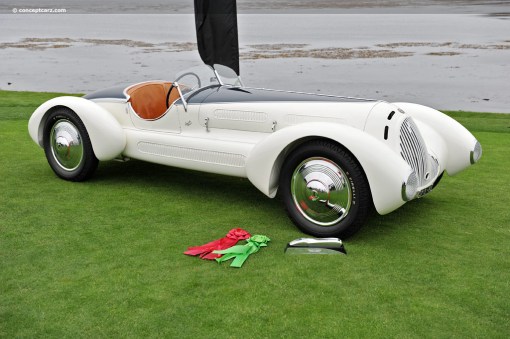
This car was spotted in the garage of the man fixing their plane. It started with a toss off line about a beautiful Alfa with a Zagato body…little did I know that a few of these existed. And they’re gorgeous. So here it is, presented for the Ubiquity system:

1931 Alfa Romeo 6C 1750 Zagato Spyder

This 1931 Alfa Romeo 6C 1750 Gran Sport is from the fifth series of production and wears coachwork by Zagato, and is equipped with a superchanged 1750cc six-cylinder engine that provided 85 horsepower at 4400 rpm. In reality, it was first registered on August 10th of 1931 in the village of Saint Varent in Southwest France to Baron Phillipe de Gunzbourg and he owned it until about 1935. He used it for racing and hill climbing events.

31-Alfa-6C-1750_GS_DV-12-PBC_020

31-Alfa-6C-1750_GS_DV-12-PBC_025

31-Alfa-6C-1750_GS_DV-12-PBC_a05

Size: 2   Def: 6   Str: 6   Spd: 100 mph   Rng: 180 mi. Han: +2   Crew: 1   Pass: 1   Cost: $5000

This week’s play centered on the player that had been absent last week, and the introduction of a new player into the group. Most of the evening was character interaction, with the leader of the crew — Zara — going to a swanky jazz club, Maxim, for the evening with an old boyfriend. She encounters the new character, John Hunter, an agent of Terra Arcanum who has been tasked with keeping Dr. Gould safe and out of the wrong hands…

Maxim was a popular jazz joint near the embassies in the Pera District (Pera Palace was the most ritzy of the hotels, at the time), a section of Istabul that was also known for being a bit “rough”, much like the International Settlement of Shanghai. In many ways, the two cities parallel each other at this time: high levels of new immigration, with those populations being refugees from Russia (and after 1933, Germany and Eastern Europe.) The big players in the underground are White Russians, and Jewish refugees from various places. Maxim was run by an American black man, the son of Mississippi slaves who had emigrated to Russia, then fled to Turkey, where he wound up running the club.

We had it as the cynosure of jazz and expatriate culture — American and German performers, the infamous Greek opuim kings — the Eliopoulous brothers, Jewish academics recently arrived from Germany… During the course of the evening, Zara encounters Pavel Rabinowitz, the head of the ring that aided the other players last week, and Olga, the knout-weilding Ukrainian girl. He was doing her the courtesy of letting her know the boys were alive and well, and what they were up to.

Eventually, during the course of play, Hunter was able to gain enough trust to be invited along for the ride, and to my surprise, they also decided to enlist Olga in their exploits.

Next up — plane trips, India, and Tibet!

One of the NPCs introduced last time that seems to have caught the players’ attention. They have recruited her into their company…

Olga Markova

olgaOlga Markov was born in Kiev in 1909. Her father and mother ran a tailor’s shop and were solidly middle-class for the Russian Empire. Her father dabbled in socialism, and he was active in helping to fund legal aid for Jews that were targeted by the legal system, but never got into trouble himself. During the Great War, the family was able to avoid terrible hardship until the October Revolution in 1917. The Ukrainian  People’s Republic was formed and her father was a member of the Ministry for Jewish Affairs. When the Soviets came, he quickly joined the Yevsektsiya — the Bolshevik organization designed to eradicate Jewish culture and Zionist movements — to protect his family.

Her father was a traitor in many Russian Jews’ eyes, and despite his best efforts, when the Yevsektsiya was disbanded in 1929, he fell afoul of the NKVD for having been a supporter of Trotsky. He and his wife were executed, and Olga’s older brother David was sent to Siberia. She, on the other hand, had attracted the attention of Mikhail Ruslan — one of the local NKVD officers, who “rescued” her, making her his consort for several years, and it is rumored, worked on turning her into an agent of the state.

She was able to escape Ruslan’s clutches by setting him up for a squad of Jewish assassins from the Rabinowitz Group during a trip to the Crimean seaside. They were not successful in killing him, but Olga finished the job for them, and thus gained her ride to Istanbul with the few surviving assassins in 1931. She is one of the most effective killers the group has…very few see her coming.

She is tall at 5’8″, with a cold, unemotional demeanor. She rarely, if ever, lets her guard drop. The aloofness seems to make her highly attractive and often men underestimate her talent for violence. Those that know her reputation find her terrifying, partl for her preference for the knout — a kind of whip that was popular with tsarist landowners, and now with some NKVD agents.

Archetype: Spy     Motivation: Revenge     Health: 5     Style: 4

Body: 2, Dexterity: 3, Strength: 2, Charisma: 3, Intelligence: 2, Willpower: 3

Size: 0, Move: 5, Perception: 5, Initiative: 5, Defense: 5, Stun: 2

Resources: Rank 1 — Rabinowitz Group

Talents: Finesse Attack, Systema and Melee

Flaws: Callous, Criminal, Hunted, NKVD

Languages: Russian & Yiddish (native), German, Hebrew

Skills: Acrobatics 1/4, Athletics 2/4, Con 2/5, Diplomacy 1/4, Firearms 2/5, Investigation 2/4, Linguistics 2/4, Martial Arts (Systema) 2/5, Melee 2/5, Performance, Acting 1/4, Stealth 2/5, Survival 2/4

Weapons: Knout     Damage: 1N   Attack Rating: 6N   Rng: 8’   Rate: 1   Spd: A

cossack knout


We had a new player join us this evening, so I had whipped up a character that could drop in quick and easy with the existing group…

John Hunter

Born in 1901 as Giovanni Cacciatore, he is the son of Genoese immigrants to Philadelphia, PA. His family chose to change their names to something more “American” when they arrived in 1908. His father, Frank, is a shipping clerk in the South Philadelphia Docks and is the “go-to man” for getting things in and out of the country quietly. John grew up on Carpenter Street, getting into trouble and running wild. He quickly picked up various talents — pickpocketing, lockpicking, and smuggling among them. Caught red handed in 1917, he was given the choice of joining the military or jail time. He joined the US Marine Corps and served in France. After the war, he remained in Paris where his sticky-fingered skills were appreciated. He had a reputation for specializing in antiquities. After a strange incident involving an ancient and esoteric object, and a mysterious “lost island” in the Indian Ocean, he was recruited by the Terra Arcanum as an agent in 1927 and rose to “overseer” in 1930.

Archetype: Spy     Motivation: Mystery     Health: 5     Style: 5

Body: 2, Dexterity: 3, Strength: 2, Charisma; 3, Intelligence: 3, Willpower: 3

Size: 0, Move: 5, Perception: 6, Initiative: 6, Defense: 5, Stun: 2

Resources: Contacts 1: smugglers, Mentor 2: Douglas VanMeer, PhD (and Master in Terra Arcanum), Rank: Overseer, Terra Arcanum

Traits: Agile, Atlanean Language

Flaws: Curious, Hunted, Secret (member of the Terra Arcanum), Vow (same)

Languages: Italian (native); English, Greek, Spanish

Skills: Academics, History 1/4, Acrobatics 2/5, Athletics 2/4, Brawl 2/4, Bureaucracy 2/5, Con 2/5, Craft, Mechanics 1/4, Diplomacy 1/4, Drive 1/4, Firearms 2/5, Investigation 2/5, Larceny 3/6, Linguistics 2/5, Melee 2/4, Ride 1/4, Stealth 2/5, Streetwise 2/5, Survival 1/4

Weapon: Colt Detective .38 special, knife

Recently, Runeslinger (aka Anthony Boyd) — a regular commenter here at Black Campbell did a nice video interview with Jeff Combos, the grand panjandrum at Exile Games and creator of Hollow Earth Expedition and the Ubiquity system. Here’s the interview for those interested…

https://www.youtube.com/watch?…

Some of the comments I found interesting were in regard to the notion of a Ubiquity 2.0. At the time Hollow Earth Expedition released, Fate hadn’t quite taken off, as Spirit of the Century was released about the same time. When it came out, Ubiquity felt very streamlined and unique. Even though it is a dice pool system, it avoids some of the traps of the ’90s dice pool games with the “take the average” mechanic, fitting the goal of less dice, less often. Still, as it has aged, the system feels…old school, and I’ve tried to pinpoint exactly what it is that has been bothering me about the game mechanics.

The first thing is combat. Where the rest of the game has a nice stripped down sort of feel — roll the dice or take the average and beat a target number of successes — combat has a very late ’80s/early ’90s “crunchiness” that is anachronistic, but also overly punitive to the players. Special maneuvers, aimed shots, off-hand use of something, ranges all incur — inevitably — a -2 penalty that stacks. Partly, this is to keep the math looking clean, but it’s also unnecessary for a pulp game.

One of the things that would make combat move faster is to have the GM set the difficult differently, instead of mucking with the number of dice you roll. Longer range? Add a difficulty level. Maybe shooting at a longer range in the rain…add two difficulty. Keep it simple. The rules system is roughly 10 pages long. Combat adds another seventeen. Much of that is dealing with the modifiers discussed above. I would suggest a good house rule is to set the difficulty at an appropriate level, or in the case of beating something’s Defense, maybe add a die or two based on conditions. Keep it simple, instead of having modifiers for every manner of blow, grapple, etc.

The second thing that stood out: Resources and Talents are very expensive, in relation to skills. For a genre where “having a schtick” is important, I think lowering the cost of these from 15 points to something like 7 or 8 would be appropriate. However, I think a reworking of the R&T rules, and a strengthening of the Flaws rules might be in order — maybe something closer to how Fate works with their Aspects. A flat benefit or penalty under certain circumstances, instead of having the player be able to stack multiple levels of, say, Knockout Blow; make them cheaper and the benefits fixed at +1 or +2.

Third, the Size rules are interesting, and designed to make large creatures easy to deal with, but the logarithmic nature, where the Size number doubles within certain ranges makes for some confusion for those who want to make new vehicles and the like. (An issue recently illustrated by our guest post on the Aerial flyers in Space: 1889.) Again, the size rules look to be part of the goal of keeping the die numbers regular, aiding the take the average notion, but it’s always been one of the stickier parts of the rules, in my opinion.

So there were a few quick thoughts on where Ubiquity might need a bit of attention in the event of a second edition. The ideas not fully formed, but those seemed to be the most obvious points of systemic weakness, in my opinion.

Born in 1894 to a line of very log-lived and accomplished Sephardic Jews in Barcelona, he was the first of three sons. His father was a surgeon, and his mother a concert pianist. He followed his father into medicine, training as a doctor and surgeon at the Universidid de Madrid in 1912 and graduating in 1916. He was one of the first doctors to be required to have a residency, which he did under his father’s tutelage at the Hospital del Mar.

He had several strikes against him in his early life: Jewish, socialist, and most damning, he “seduced” the daughter of the Marquise de Azaña, Inez. H met her at a performance of Don Giovanni in 1924, and the coupe fell madly in love. Their tryst was discovered by her brother, Manuel Azaña y Vega — a highly-placed member of the Civil Guard, who brought him up on false charges. He was given the option of exile or trial, and he has been on the move ever since, plying his services in various places.

After the collapse of the military junta in 1931, he thought he might be able to return home, only to be nearly murdered by the police. He fled to Equatorial Guinea as a company doctor for the Empressa Maderera Ecuatorial, a mining company in the mountains.

He is exceptionally well-read and educated, an excellent and experienced trauma surgeon, and is very well traveled.

Archetype: Doctor   Motivation: Escape   Style: 5   Health: 5

Body: 2, Dexterity: 3, Strength: 2, Charisma: 3, Intelligence: 4, Willpower: 3

Size: 0, Move: 5, Perception: 7, Initiative: 7, Defense: 5, Stun: 2

Resources:

Traits: Agile, Atlantean Blood, Intelligent, Skill Mastery (Academics and Science), Weird Science (Biology)

Flaws: Addiction (alcohol), Condescending, Hunted, Weirdness Magnet

Languages: Spanish and Hebrew (native); Arabic, English, French, German, Portuguese

Skills: Academics 2/6, Art, Music 1/4, Athletics 2/4, Bureaucracy 2/6, Con 2/5, Diplomacy 2/5, Drive 1/4, Firearms 1/4, Larceny 1/4, Linguistics 4/8, Medicine 3/7, Performance, Piano 1/4, ride 1/4, Science 2/6, Stealth 1/4, Streetwise 3/6, Survival 1/5

Weapon: Colt Detective Special .38 special 2″ barrel — Damage 2L   Rng: 50′   Cap: 6 (r)   Rate: M   Spd: A; Mauser M1898 7mm bolt-action rifle — Damage: 3L   Rng: 100′   Cap: 5(c)   Rate: M   Spd: A


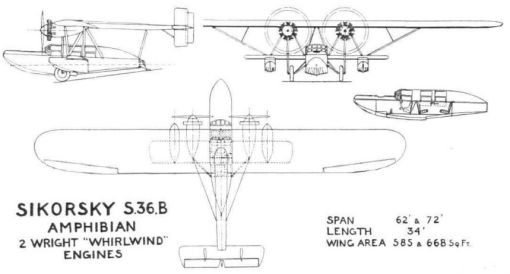
While similar to its successor, the S-38, the Sikorsky S-36 is featured in our current campaign, so here it is in all its subdued glory…

Bernadette, a 1927 Sikorsky S-36 Air Yacht

The S-36 is an eight-seat flying boat first debuted in 1927, and produced for Pan American Airlines. The S-36 improved on the S-34 with room for two more passengers, double the range (with a typical range of about 750 miles, although this can be extended with extra gas tanks lashed under the wings, on top of the cabin), and Wright Whirlwind J-5 radial motors producing a total of 400hp. Like the S-34 and its successor, the S-38, these airplanes featured a boat hull fuselage that was connected to the wing and tail structure by a trellis frame. The S-36 features retractable wheels for ground landings.

Only six of these craft were built before the improved S-38 entered service in 1928.

817-1

Passengers face each other in bench seats, which face fore and aft. Bernadette began life as a Pan Am short hop airplane — she is #5 of six built, and has registry number G-AAER. Her owner, Lady Ansom-Bose, has pulled one of the bench seats to make room for a drinks cabinet near the back of the cabin, so the aircraft can only hold four passengers, now.

Size: 8   Def: 4   Str: 8   Speed: 120mph   Ceiling: 15,000′   Range: 750mi.**   Han: -2   Crew: 2   Pass: 4   Cost: $5,000 (used)

** With the external tanks for fuel, Bernadette has a range of 900mi. and a ceiling of 14,500′.